


If you’re setting prices for your store and keep second-guessing your margins, you’re not alone. The wholesale vs retail price formula is one of the most misapplied concepts in eCommerce mostly because people confuse markup with margin and end up underpricing without realizing it.
This guide clears that up. You’ll see exactly how wholesale and retail pricing work, why markup and margin are not the same thing, and how to apply the right formula for your pricing decisions.
Quick Answer: The wholesale vs retail price formula works like this — wholesale price is your cost plus a markup for the supplier’s margin; retail price is your wholesale cost plus a further markup to cover operating costs and profit. The gap between these two prices is where your margin lives, and getting it right is what separates profitable stores from ones that merely look busy.

Table of Contents
What Is Wholesale Pricing?

Wholesale pricing is the price a manufacturer or distributor charges a reseller, a retailer, an online store, or a B2B buyer for goods purchased in bulk. Because you’re buying in volume and not paying for retail infrastructure, the per-unit price is lower.
Wholesale prices typically run 30–50% below the final retail price, though this varies significantly by product category and supplier relationship. The buyer takes on storage, distribution, and the cost of selling, in exchange for a lower entry price.
For WooCommerce store owners selling B2B, wholesale pricing is what you set for your approved wholesale customers, often via role-based pricing rules that hide the discount from regular shoppers.
What Is Retail Pricing?

Retail pricing is the final price a consumer pays. It’s set by the retailer — not the manufacturer — and has to cover more than just the cost of goods. It needs to absorb marketing costs, shipping, payment processing fees, returns, and the overhead of running the business.
A common starting point is keystone pricing — doubling the wholesale cost to set the retail price. But that’s a rough rule of thumb, not a strategy. Actual retail pricing depends heavily on your category, competition, and perceived value.
According to NYU Stern School of Business data (January 2024), the average gross profit margin for general retail is 30.9%, with net margins averaging just 3.1% after all operating costs are accounted for. That gap is why getting your pricing formula right matters so much.
Wholesale vs Retail Price: Key Differences
| Wholesale Price | Retail Price | |
| Who pays it | Retailers, resellers, B2B buyers | End consumers |
| Pricing basis | Cost + supplier margin | Wholesale cost + retailer markup |
| Volume assumption | Bulk orders | Individual units |
| Margin per unit | Lower | Higher |
| Overhead included | Minimal | Marketing, rent, staff, returns |
| Who sets it | Manufacturer or distributor | Retailer |
The relationship between the two is straightforward: your retail price needs to be high enough above your wholesale cost to cover everything it costs you to actually sell the product.
The Wholesale vs Retail Price Formula
Here are the two core formulas. Keep them simple, you can build on them once you’ve got the basics right.
Wholesale Price Formula:
Wholesale Price = Cost of Goods + (Cost of Goods × Wholesale Markup %)
Example: Your product costs $10 to produce. You want a 30% markup.
$10 + ($10 × 0.30) = $13 wholesale price
Retail Price Formula:
Retail Price = Wholesale Price + (Wholesale Price × Retail Markup %)
Example: Your wholesale price is $13. You want a 54% retail markup.
$13 + ($13 × 0.54) = $20 retail price
For a deeper walkthrough of the calculation method and how to factor in variable costs, see How to Calculate Wholesale Prices.
Markup vs Margin: The Difference Most Sellers Get Wrong
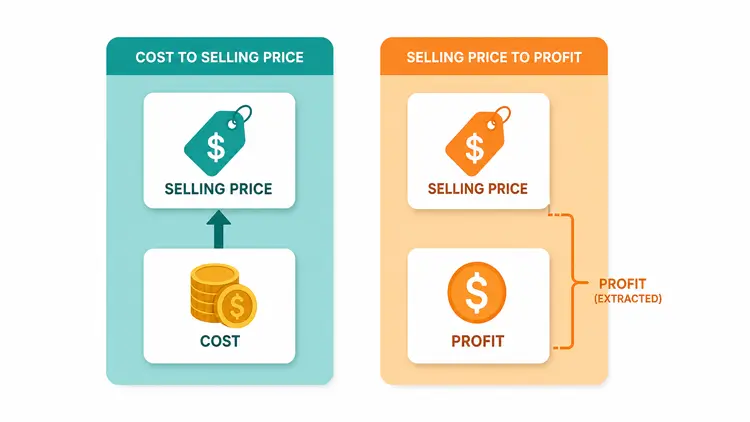
This is the section that matters most if you’re setting prices for your store. Markup and margin are not the same thing, and mixing them up is one of the most common (and costly) mistakes in pricing.
A 50% markup does not mean a 50% profit margin. A product with a 50% markup actually has a 33.3% margin. Many store owners don’t realize this until they check their books at year-end and wonder where the profit went.
The Formulas
Markup is based on your cost:
Markup % = (Selling Price − Cost) ÷ Cost × 100
Margin is based on your selling price (revenue):
Margin % = (Selling Price − Cost) ÷ Selling Price × 100
The only difference is the denominator — but it produces very different numbers.
Side-by-Side Example
Product cost: $60 | Selling price: $100 | Gross profit: $40
| Metric | Formula | Result |
|---|---|---|
| Markup | $40 ÷ $60 × 100 | 66.7% |
| Margin | $40 ÷ $100 × 100 | 40% |
Both refer to the same $40 profit, but expressed differently. If you tell a supplier “I need 40% markup” but mean 40% margin, you’ll underprice every order.
Markup vs Margin Conversion
If you know one, you can calculate the other:
- Markup → Margin: Margin % = Markup % ÷ (1 + Markup %)
- Margin → Markup: Markup % = Margin % ÷ (1 − Margin %)
Quick example: A 50% markup converts to: 0.50 ÷ 1.50 = 33.3% margin
Which One Should You Use?
Use markup when you’re setting prices — it starts from your known cost and tells you what to charge.
Use margin when you’re evaluating profitability — it tells you what percentage of each sale you actually keep after covering your cost.
Smart pricing decisions use both. Price using markup; evaluate using margin.
Industry Benchmarks: Typical Wholesale and Retail Margins
These are realistic ranges based on industry data. Use them as benchmarks, not hard targets, your actual margins will depend on your supplier relationships, operating costs, and competitive positioning.
| Industry | Typical Wholesale Markup | Typical Retail Gross Margin | Notes |
|---|---|---|---|
| Clothing / Apparel | 50–100% | 50–65% gross | Fashion wholesale markup often 120–160% for brands |
| Electronics | 15–25% | 30–50% gross | Lower margins; high volume; competitive pricing |
| Beauty / Cosmetics | 60–100% | 65–85% gross | Brand equity drives pricing power; perfume can hit 85% |
| Furniture | 80–150% | 45–65% gross | High logistics costs reduce net margin significantly |
| Food / Grocery | 10–25% | 25–35% gross | Tight margins; volume-dependent |
| Jewelry | 100–200% | 40–60% gross | Wide range; handmade vs mass-produced differ heavily |
Data sources: NYU Stern School of Business (January 2024); Eightx eCommerce Margin Report (March 2026); JOOR Wholesale Fashion Benchmark (2024).
Industry Examples in Practice
Clothing boutique: Buys t-shirts wholesale at $15. Applies a 70% retail markup.
$15 + ($15 × 0.70) = $25.50 retail price
Gross margin: ($10.50 ÷ $25.50) × 100 = 41.2%
Electronics retailer: Buys smartphones wholesale at $200. Applies a 40% markup.
$200 + ($200 × 0.40) = $280 retail price
Gross margin: ($80 ÷ $280) × 100 = 28.6%
Cosmetics brand: Buys product at $8 per unit. Applies a 100% wholesale markup, then retailer adds 75%.
Wholesale: $8 + $8 = $16
Retail: $16 + ($16 × 0.75) = $28 retail price
Retailer gross margin: 42.8%
How to Manage Both Pricing Models in WooCommerce
Running wholesale and retail pricing at the same time is where most store owners hit friction. You have one product, two (or more) prices, and a need to make sure the right customer sees the right number.
Here’s a practical workflow for a WooCommerce store:
- Set your base cost, your COGS including landed cost, any import fees, and inbound shipping.
- Calculate your wholesale price using your target markup. This is what your B2B buyers see.
- Calculate your retail price from the wholesale price using your retail markup. This is your public price.
- Use role-based pricing with a plugin like WPWhols; you can assign wholesale prices to approved customer roles (wholesale buyer, distributor, agent) without manually creating separate product variants. Regular visitors see the retail price; logged-in wholesale users see their rate.
- Set minimum order quantities — wholesale pricing usually only makes sense above a certain volume. Enforce this at the role or product level so single-unit buyers pay retail.
- Review pricing quarterly — costs change, competition shifts, and currency fluctuations affect landed cost. A quarterly review keeps your margins from quietly eroding.
Want to set this up on WooCommerce? Read How to Set Wholesale Prices in WooCommerce: Basic Steps for a step-by-step walkthrough.
Common Pricing Mistakes That Shrink Your Margins
These aren’t abstract warnings; they’re the specific errors that quietly drain profit from otherwise well-run stores.
- Using markup when you mean margin: The most common mistake; always confirm which formula you’re applying before finalizing a price.
- Forgetting landed cost: Your cost isn’t just the supplier invoice; it includes shipping, customs, inspection, and any storage fees before the product reaches your warehouse.
- Setting and forgetting: Supplier prices shift, shipping rates change, and platform fees increase; prices that worked in 2024 may be losing you money in 2026.
- One-size pricing for all channels: Your DTC margin on Shopify is different from your wholesale margin on Faire; channel costs vary, and your pricing should reflect that.
- Ignoring payment processing fees: Stripe and similar processors charge 2.5–3.5% per transaction; this adds up fast and needs to be baked into your retail price or margin targets.
Related: How to Boost Wholesale Profit Margins — practical strategies for improving margin without raising prices across the board.
Frequently Asked Questions
What is the difference between wholesale and retail price formula?
The wholesale price formula adds a supplier markup to the cost of goods:
Wholesale Price = Cost + (Cost × Markup %).
The retail price formula adds a further markup to the wholesale price:
Retail Price = Wholesale Price + (Wholesale Price × Markup %).
The key difference is who pays each price and what costs each price needs to cover.
Is markup the same as profit margin?
No. Markup is calculated as a percentage of your cost; margin is calculated as a percentage of your selling price. A 50% markup results in a 33.3% margin, not 50%. Always confirm which metric you’re using when making pricing decisions.
What is a healthy wholesale margin?
This depends heavily on your category. A general benchmark is a gross margin of 20–40% at the wholesale level, with retail margins typically running higher to cover marketing, returns, and operating overhead. Beauty and cosmetics brands often achieve 65–85% gross margin at retail; electronics typically land at 30–50%.
Can I run wholesale and retail pricing on the same WooCommerce store?
Yes. Using role-based pricing tools like WPWhols, you can display different prices to different customer types, wholesale buyers, retailers, distributors, and regular consumers, all from a single product catalog. No duplicate products or manual workarounds needed.
How often should I review my pricing formula?
At minimum, quarterly. You should also review whenever a supplier changes their price list, when your shipping or processing costs shift significantly, or when a key competitor adjusts their pricing. Pricing isn’t a one-time decision, it’s an ongoing part of running a profitable store.
What’s the right retail markup percentage?
There’s no universal answer. Keystone pricing (2× wholesale cost = retail price) is a common starting point, giving you roughly a 50% gross margin. But whether that’s right depends on your category, competition, and overhead. Use your margin target to work backward: if you need a 45% gross margin, divide your cost by (1 − 0.45) = 0.55 to find your minimum retail price.
Conclusion
Getting your wholesale vs retail price formula right is ultimately about knowing your costs, choosing the right markup, and tracking the margin you actually keep on every sale.
When you understand the difference between wholesale and retail pricing and between markup and margin, you can set prices that support growth instead of eroding profit over time.
Managing wholesale and retail pricing in WooCommerce doesn’t have to be complicated. WPWhols handles role-based pricing, minimum order rules, and wholesale registration, so your pricing structure works automatically, without manual overrides.
If you’re ready to put these formulas into action, try the free WooCommerce wholesale plugin, WPWhols, to see your profit margins clearly and keep your wholesale and retail pricing in sync.