


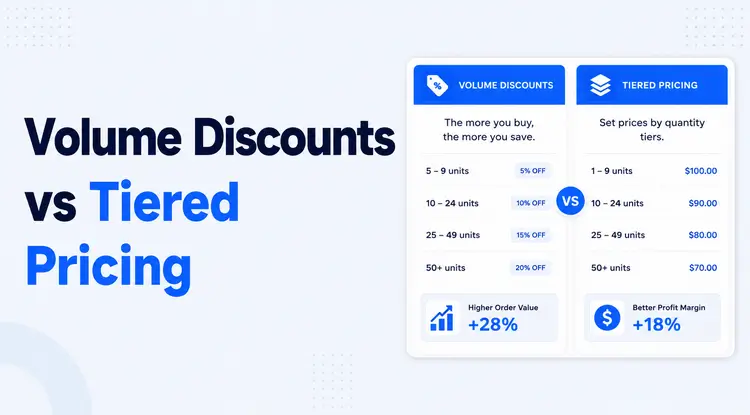
Quick Answer: Both volume discounts and tiered pricing help wholesalers sell more — but they work differently. Volume discounts reward customers who hit a set quantity threshold. Tiered pricing rewards every extra unit they buy, progressively. For most WooCommerce wholesale stores, tiered pricing wins on average order value (AOV), margin protection, and long-term customer loyalty. But volume discounts still make sense for commodity products and fast inventory clearance
The B2B wholesale market is worth an estimated $32.1 trillion globally in 2025, growing at 14.5% annually. Yet 70% of wholesalers still fail to implement their pricing strategies effectively — leaving serious profit on the table.
That gap usually comes down to one decision: choosing the wrong pricing model for their customers.

If you run a WooCommerce wholesale store, you’ve almost certainly asked yourself: Should I offer volume discounts or set up tiered pricing? They look similar on the surface, but the mechanics and the results are very different.
This guide breaks both models down with real numbers, real case studies, and a clear framework for choosing the right one. We’ll also show you how to set either model up in WooCommerce using Whols.
Table of Contents
Key Takeaways
- Tiered pricing typically increases average order value (AOV) by 25–40%
- Volume discounts are simpler to communicate and work well for commodity products
- Tiered models protect your profit margins better over time
- Volume discounts reward big single orders; tiered pricing builds long-term relationships
- A hybrid approach (tiered volume discounts) often works best for diverse customer bases
- WooCommerce plugins like Whols handle both models without manual errors
Understanding Volume Discounts and Tiered Pricing: Core Definitions
Before choosing between these two models, you need to understand how each one actually works not just in theory, but in terms of what happens in a customer’s head when they see your pricing.
What Are Volume Discounts?
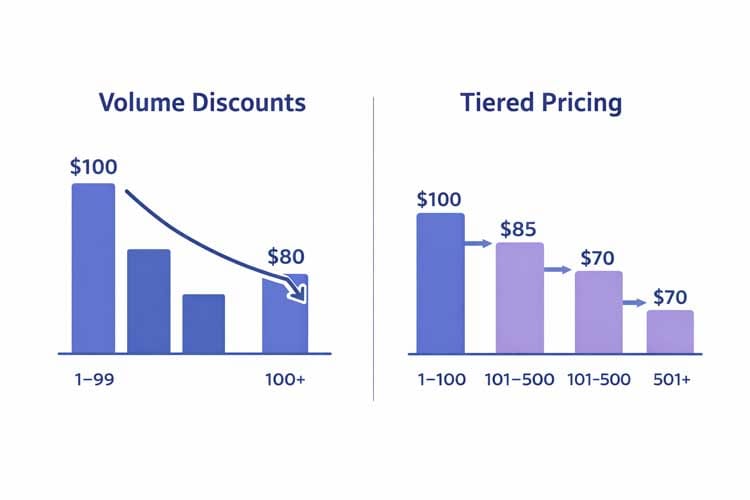
Volume discounts apply a single discounted rate to an entire purchase once a customer meets a specific quantity threshold. All units purchased receive the same discount level.
Real-world example:
- Customer buys 1-99 units: No discount, standard pricing $100/unit
- Customer buys 100+ units: $80/unit applied to ALL units
So a customer buying 95 units pays $9,500. One buying 100 units pays $8,000. That $1,500 difference for just 5 extra units creates a powerful psychological push to hit the threshold.
What Is Tiered Pricing?
Tiered pricing structures multiple price levels where different quantity bands are charged at different rates. Customers pay progressively lower prices as they buy more, but each tier has its own pricing.
Real-world example:
- Units 1-100: $100 per unit
- Units 101-500: $85 per unit
- Units 501+: $70 per unit
For a customer buying 300 units: They pay $100 for the first 100, then $85 for the next 200, totaling $27,000 instead of $30,000 at flat pricing.
That’s a meaningful saving, but note how it’s spread across the order rather than hitting all at once.
The Core Difference
| Element | Volume Discounts | Tiered Pricing |
|---|---|---|
| Discount application | Entire order, once threshold is met | Each band at its own rate |
| Customer psychology | All-or-nothing urgency (FOMO) | Incremental progress, status |
| Margin risk | Higher (steep cliff discounts) | Lower (graduated discounting) |
| Best for | Commodity products, clearing stock | Diverse customer bases, long-term relationships |
| AOV impact | 15–25% increase | 25–40% increase |
How Volume Discounts Actually Work
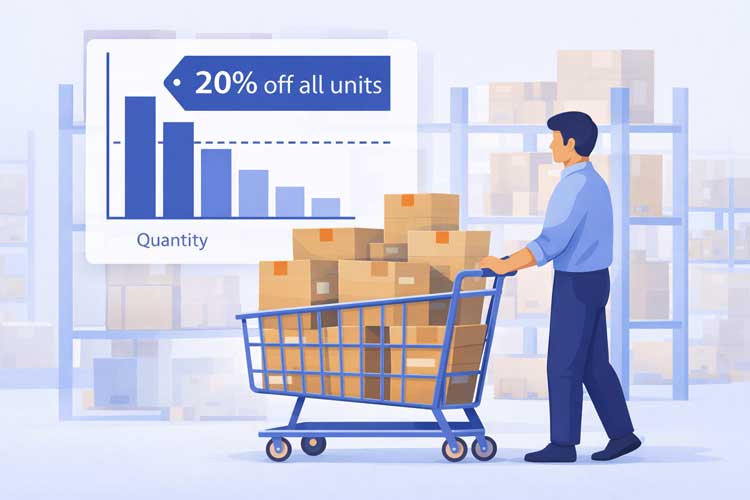
Volume discounts operate through a simple mechanism that creates surprisingly strong behavior changes in wholesale buyers.
The Pricing Cliff
The “pricing cliff” is what makes volume discounts so powerful — and so risky. At a specific quantity threshold, the per-unit cost drops sharply.
- 99 units: $9,900 total
- 100 units: $8,000 total (all units at $80)
- Net effect: ordering 1 more unit saves $1,900
Research consistently shows that customers frequently increase order sizes specifically to cross these threshold points. That’s the upside. The downside? Once they’ve crossed it, there’s no further incentive to order more.
Real-World Examples
Amazon Business uses volume discounts for B2B customers: under 100 units at full price, 100–500 units at 10% off, 500+ at 20% off.
Coca-Cola runs dealer-specific volume discounts: moderate savings for 50–100 case orders, significant discounts for 1,000+ case orders. The model works because Coca-Cola sells a commodity product where price is the primary driver.
Alibaba applies tiered volume discounts by supplier region — a hybrid approach that reflects the different margin structures across their supply chain.
Psychology Behind Volume Discounts
Volume discounts trigger a specific kind of urgency that tiered pricing doesn’t:
- FOMO: “I’m only 5 units away from saving $500.”
- All-or-nothing framing: Either you hit the threshold or you don’t — no middle ground.
- Reference price effect: The full price becomes the anchor, making the discounted price feel like an exceptional deal.
For customers who already buy in bulk, this works very well. For mid-sized buyers who don’t quite reach the threshold, it can feel frustrating.
Setting Up Volume Discounts in WooCommerce
Setting this up manually is tedious and error-prone — especially if you have multiple products or wholesale roles.
With Whols, you can:
- Set quantity thresholds (e.g., 100, 250, 500 units)
- Define discount percentages per threshold (10%, 20%, 30%)
- Apply all-units pricing automatically once a cart hits the threshold
- Display pricing tiers clearly on product pages so buyers can see what they’re working toward
The wholesale b2b plugin handles the calculation automatically based on cart quantity, so you don’t have to worry about applying the wrong price to the wrong order.
You can check the step-by-step setup guide if you’re just getting started.
How Tiered Pricing Works
Tiered pricing is more nuanced than volume discounts, but once customers understand it, they often prefer it — because it feels fairer.
The Bronze/Silver/Gold Structure
The most effective tier systems use names that create psychological differentiation, not just price points.
Bronze (Entry): 10–49 units, smallest discount
- Psychology: “I’m testing this relationship.”
- Benefit: Lower commitment barrier for new customers
Silver (Professional): 50–99 units, mid-range discount
- Psychology: “I’m a serious, repeat buyer.”
- Benefit: Sweet spot for established accounts
Gold (Enterprise): 100+ units, steepest discount
- Psychology: “I’m your most valued partner.”
- Benefit: Reward and lock in your highest-volume customers
Research shows that tier naming significantly affects perceived value. “Professional” feels different from “Medium.” “Gold” implies status, not just a number. Customers aspire to reach the next level — and that’s exactly what you want.
Why 3–5 Tiers Work Best
Too few tiers limit options. Too many create decision paralysis. A 3-tier structure is the sweet spot for most wholesalers:
- Entry tier: 10% discount, low volume
- Middle tier: 20% discount, moderate volume
- Premium tier: 30% discount, high volume
If you have a complex product line with clearly different buyer segments, a 5-tier structure can work — but anything beyond that typically hurts conversion.
Real Company Examples
- HubSpot built a tiered SaaS model where 25% of customers upgrade to a higher tier within 6 months. The tiering creates an aspirational ladder; customers don’t just buy; they grow into the product.
- Zendesk reported a 35% increase in customer lifetime value after implementing tiered pricing, because customers were more invested in the relationship.
- AWS converts 60% of customers to 1–3 year commitments through tiered volume pricing. The longer the commitment, the better the rate, a powerful loyalty mechanism.
Setting Up Tiered Pricing in WooCommerce
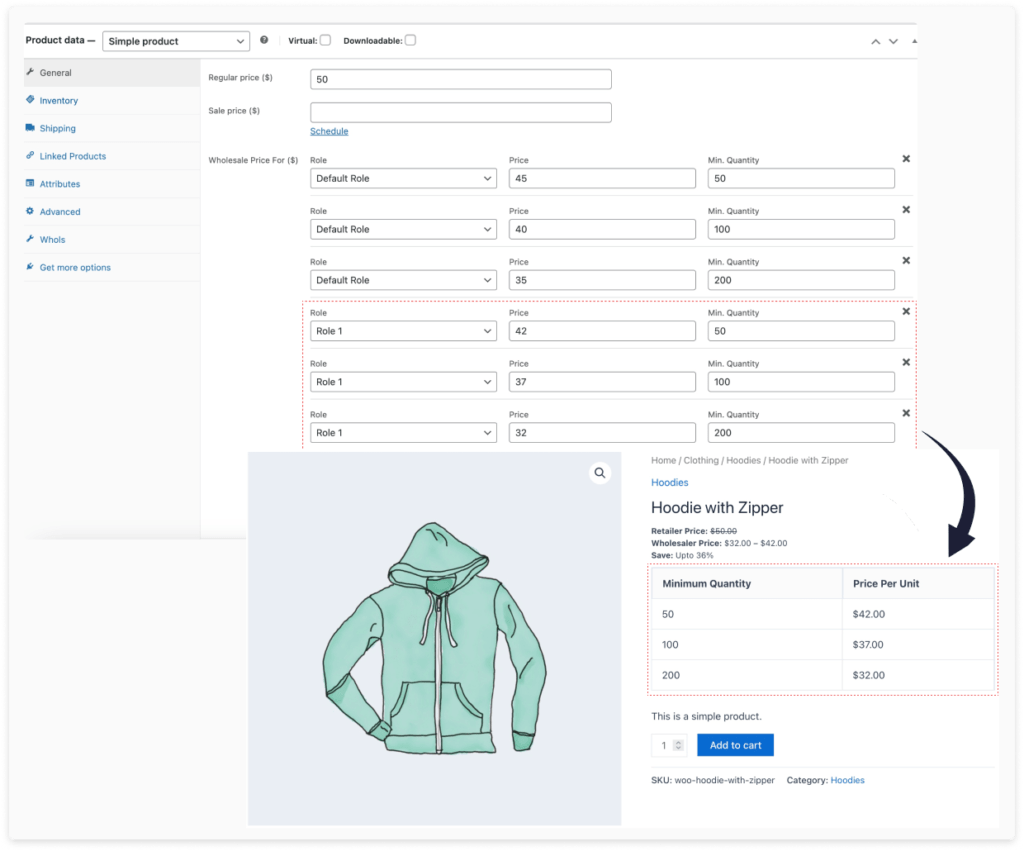
Whols makes tiered pricing significantly easier to manage than doing it manually. You can:
- Create multiple pricing tiers with custom names (Bronze, Silver, Gold)
- Set different pricing for different wholesale user roles
- Apply category-level pricing so all products in a category follow the same tier structure
- Automate pricing based on customer role and cart quantity
- Use the Dynamic Rules feature to combine tiered pricing with cart-wide discounts or BOGO offers
You can also see how tiered pricing works in practice for WooCommerce stores in the Whols documentation.
Key Differences: Volume Discounts vs Tiered Pricing
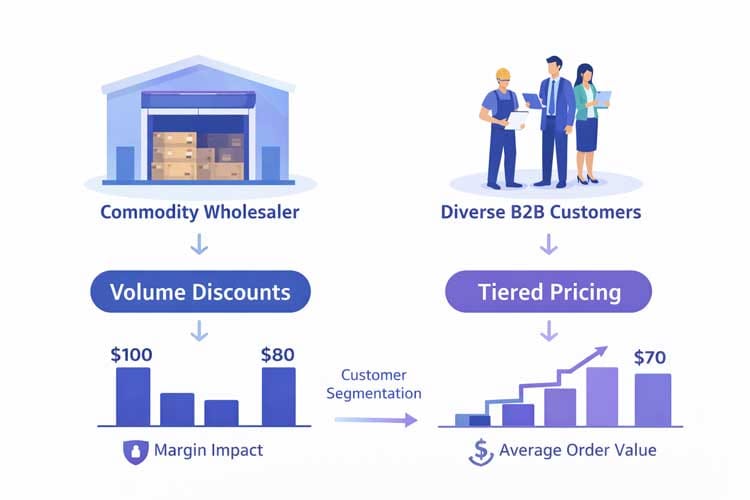
Let’s compare these models across dimensions that actually matter for running a wholesale business:
| Dimension | Volume Discounts | Tiered Pricing |
|---|---|---|
| Discount application | One rate once threshold met | Different rates per quantity band |
| Customer comprehension | Simple (one threshold) | Requires slightly more explanation |
| Revenue predictability | Unpredictable (clustering around thresholds) | Smoother and more forecastable |
| Margin protection | Lower (steep single discount) | Higher (incremental discount) |
| Customer segmentation | Works for homogeneous buyer bases | Excellent for diverse segments |
| AOV impact | +15–25% | +25–40% |
| Psychological driver | FOMO / urgency | Progress/status motivation |
A Concrete Example
For a customer ordering 250 units:
| Model | Units 1–100 | Units 101–250 | Total Cost |
|---|---|---|---|
| Volume Discount (250+ threshold) | $100 | $100 | $25,000 |
| Tiered Pricing | $100 | $85 | $22,750 |
In this scenario, tiered pricing gives the customer a better deal while the wholesaler loses less margin, because only 150 of the units get the deeper discount, not all 250.
Which Model Increases Average Order Value More?
This is the question most wholesalers ask first. The answer is clear from the data.
The Numbers
McKinsey research shows that tiered pricing increases AOV by 25–40% compared to flat wholesale pricing. Volume discounts typically increase AOV by 15–25%.
Why the gap?
Volume discounts create binary outcomes. Customers either hit the threshold or they don’t. If they hit it, they don’t need to order more. If they don’t, there’s no incremental reward for trying harder.
Tiered pricing creates continuous progression. Every additional unit the customer orders gives them a slightly better deal. There’s always a reason to add a few more items to the cart.
The Customer Journey Difference
Under volume discounts:
- Month 1: Small test order
- Month 2: Customer discovers threshold, increases to hit it
- Month 3+: Order size plateaus — no reason to go higher
Under tiered pricing:
- Month 1: Small order at Bronze pricing
- Month 2–3: Natural growth into Silver tier
- Month 4–6: Customer targets Gold tier
- Month 7+: Consistent Gold-tier volumes with strong loyalty
Tiered pricing builds an escalator. Volume discounts build a plateau.
Psychological Anchoring
Both models use anchoring, but differently.
Volume discounts anchor on the full price. The discounted price feels like a dramatic deal once the threshold is hit.
Tiered pricing anchors on tier identity. “Professional” feels better than “standard.” Customers aspire to be Gold-tier buyers; that status motivation drives spending beyond what a simple discount would.
Pricing Psychology: Why Customers Respond the Way They Do
Understanding why these models work helps you apply them more strategically.
Left-Digit Bias
Your brain processes numbers from left to right. $9,999 feels dramatically cheaper than $10,000, even though the difference is $1. This matters when you set your tier thresholds.
- Volume discounts: Position your threshold at a charm price. A 100-unit minimum at $4,999.99 total feels like less of a leap than $5,000.
- Tiered pricing: Set tier boundaries at psychologically natural breakpoints ($8,499 for Silver, $14,999 for Gold).
FOMO in Volume Discount Structures
Volume discounts excel at creating urgency:
- “I’m 5 units away from saving $500.”
- “If demand drops, will this discount tier disappear?”
- “Other buyers are getting better prices than me.”
This urgency drives immediate action. But it fades once the threshold is clear and crossed.
Status Motivation in Tiered Systems
Tiered systems tap into something deeper — identity and status:
- Bronze buyers want to feel like Silver buyers.
- Silver buyers want to reach Gold.
- Gold buyers want to stay Gold.
This ongoing motivation keeps customers engaged with your store and their relationship with your business, not just with a single purchase decision.
Behavioral Segmentation
Different customer types respond differently:
| Buyer Type | Better Model | Reason |
|---|---|---|
| Large commodity buyer | Volume discounts | Buys in bulk by default, values simplicity |
| Growing small business | Tiered pricing | Benefits from entry-level tier; has room to grow |
| Seasonal buyer | Volume discounts | Makes large infrequent orders near threshold |
| Loyal repeat buyer | Tiered pricing | Rewards consistency; builds identity |
| New customer | Tiered pricing | Low-commitment entry point |
If you’re not sure which category your customers fall into, check out how wholesalers typically structure their customer segments; it gives useful frameworks for thinking through buyer behavior.
Volume Discounts: When They’re the Right Choice
Despite tiered pricing’s AOV advantage, volume discounts are genuinely the better model in specific situations.
Strategic Advantages
1. Simplicity for buyers
One threshold. One decision. Fast. Buyers who purchase large quantities regularly don’t want to think about multiple tiers — they want to know: what’s my price at X units?
2. Aggressive bulk-buying incentive
Volume discounts create maximum psychological pressure to increase order size. That’s useful when you need to move inventory fast.
3. Rapid inventory turnover
If you’re clearing seasonal stock or managing overstocked categories, volume discounts are the faster tool. The cliff mechanism pushes customers to order more in fewer transactions.
4. Best use cases:
- Commodity products with thin margins and homogeneous demand
- Seasonal businesses clearing end-of-line stock
- Market entry, when you’re competing on price to win customers quickly
- Supplier consolidation, when you want buyers to concentrate their purchases with you
A Real Result
One B2B office supply wholesaler applied volume discounts to their top 10 SKUs. Average order size increased 22% within a quarter. Inventory turnover improved 35%. Revenue increased without needing to change margins on other products.
Tiered Pricing: When It Creates Long-Term Growth
Tiered pricing builds something volume discounts can’t: a relationship escalator.
Strategic Advantages
1. Works for every customer size
Small buyers get entry-tier discounts. Growing buyers move up. Enterprise buyers get the best rates. Nobody feels penalized for not being your biggest account.
2. Better margin protection
Incremental discounting means your steepest discount only applies to units above the top threshold — not to the whole order. This can save several percentage points of margin per order compared to equivalent volume discount structures.
3. Predictable revenue
Customer distribution across tiers stabilizes revenue. You can forecast quarterly performance far more accurately when you know how many Silver and Gold accounts you have.
4. Best use cases:
- Diverse customer bases with different business sizes
- Premium products where brand value matters
- Long-term partnership focus (distributors, resellers, agents)
- Complex product lines where different customers need different assortments
A Real Result
A wholesale furniture distributor implemented Bronze/Silver/Gold pricing:
- Bronze (1–50 units): 5% discount
- Silver (51–150 units): 15% discount
- Gold (151+ units): 25% discount
Result: AOV increased 28%, customer retention improved 18%, and gross margin only decreased 2% — far less than a comparable volume discount structure would have cost them.
Implementation: Setting Both Models Up in WooCommerce
Here’s how to actually build either model in your WooCommerce store.
Plugin Recommendation: Whols
Whols is built specifically for WooCommerce wholesale stores. It handles both volume discounts and tiered pricing, plus role-based pricing, registration forms, and dynamic rules. Pricing starts at $79/year for a single site or $199 lifetime. For 5 sites it’s $149/year ($299 lifetime), and unlimited sites run $249/year ($499 lifetime).
There’s also a free version you can try before committing.
Step-by-Step: Volume Discounts
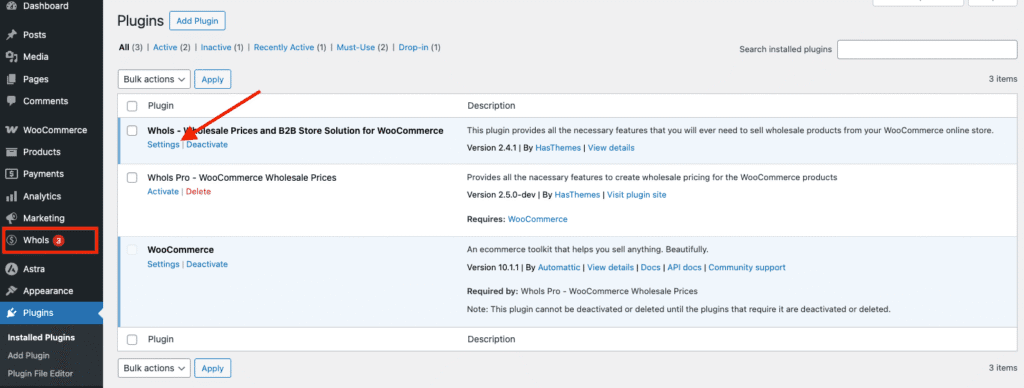
- Install and activate Whols
- Go to Whols > Settings > Pricing.
- Choose your pricing model and select the wholesale role(s) to apply it to
- Set your quantity threshold (e.g., 100 units)
- Set your discount percentage or fixed price.
- Enable “apply to all units” so the discount applies to the entire cart once the threshold is met.
- Test with a wholesale test account before going live.
Step-by-Step: Tiered Pricing
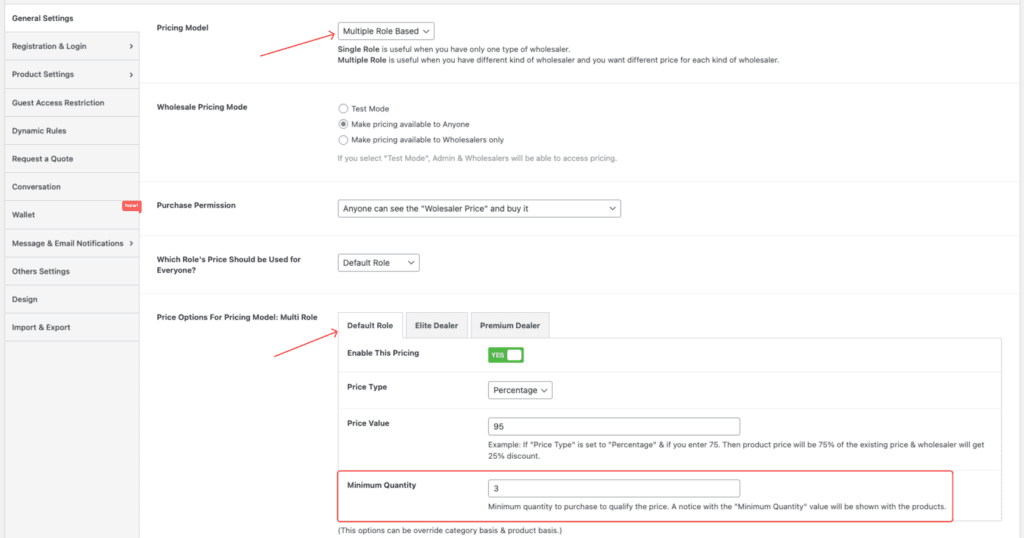
- In Whols > Settings, select the Multiple Role pricing model
- Create your wholesale roles (Bronze, Silver, Gold) — each gets its own pricing
- Set discount percentages per role:
- Bronze: 10% off
- Silver: 20% off
- Gold: 30% off
- Set minimum quantity per role (e.g., Silver requires 50+ units)
- Apply pricing at category level for bulk efficiency, or per-product for specific items
- Enable the Dynamic Rules feature for additional logic (cart-wide discounts, BOGO, free shipping thresholds)
Using Dynamic Rules for Advanced Scenarios
Whols’ Dynamic Rules feature goes beyond basic pricing. You can build rules like:
- Wholesale volume discount: 15% off the entire cart when B2B customers buy 50+ units
- Role-based rewards: Gold members get 20%, Silver 15%, Bronze 10% — applied automatically
- Cart total triggers: Extra 5% off for wholesale customers when cart exceeds $1,000
- BOGO offers: Buy one product, get another free — great for trade promotions
- Free shipping thresholds: Grant free shipping for Gold-tier or high-value orders
This level of automation removes manual work and eliminates pricing errors. You can set the rules once and let the plugin handle the rest.
Category-Based vs. Product-Specific Pricing
One of the most practical decisions you’ll make: set pricing at the category level or per product.
Category-level pricing (recommended for most stores):
- Set it once, applies to every product in the category
- Efficient for large inventories
- Easy to update — change one setting, update hundreds of products
Product-specific pricing:
- Override category pricing for individual items
- Useful for hero products, limited editions, or high-margin SKUs
- Combine with category pricing for a flexible, hybrid approach
A/B Testing Your Pricing
Once you’ve set up either model, test it:
- Run volume discounts for one month on a category; switch to tiered pricing the next
- Track: AOV, cart abandonment rate, order frequency, and gross margin
- Survey a sample of customers about which model they found clearer
- Adjust thresholds and tier boundaries based on where customers naturally cluster
Real-World Case Studies
Case Study 1: B2B Office Supply Wholesaler (Volume Discounts)
Situation: Commodity products, primarily price-sensitive buyers, high SKU count.
Choice: Volume discounts — $5,000 minimum order threshold for 15% off all units.
Result:
- Average order size increased 22% within one quarter
- Inventory turnover improved 35%
- Won 3 enterprise contracts previously held by competitors
Why it worked: The buyer base was homogeneous and already large-volume. A simple threshold made the decision easy.
Case Study 2: Furniture Wholesaler (Tiered Pricing)
Situation: Mixed customer base — small boutiques, mid-sized retailers, regional chains.
Choice: Bronze/Silver/Gold structure with 5%, 15%, and 25% discounts.
Result:
- AOV increased 28%
- Retention improved 18%
- Gross margin only dropped 2% despite higher discount levels
Why it worked: Diverse customers needed a structure that served each segment. Boutiques didn’t feel penalized for small orders; chains were incentivized to grow.
Case Study 3: Tech Distributor (Hybrid Tiered Volume Discounts)
Situation: Large enterprise buyers alongside emerging SMB accounts.
Choice: Combined model — tiered pricing at the product level, volume discount triggers at the cart level using Dynamic Rules in Whols.
Result:
- Enterprise accounts maintained Gold-tier status consistently
- SMB accounts naturally grew from Bronze to Silver
- Revenue increased 22%; margin compression limited to 4%
Why it worked: The hybrid approach let different customer segments respond to the incentive that suited them best.
Case Study 4: GE Healthcare (Enterprise Tiered Pricing)
GE Healthcare uses tiered pricing across their B2B medical equipment distribution. Hospital systems that commit to higher annual volumes get progressively better pricing, plus dedicated account support. This model turns pricing into a long-term partnership tool — not just a transaction mechanism.
Common Mistakes to Avoid
1. Setting Thresholds Without Checking Your Data First
Many wholesalers set threshold points based on gut feel. Check your actual order distribution first. If most customers order 80–90 units, a 100-unit threshold might be reachable, but a 250-unit threshold will frustrate everyone.
2. Too Many Tiers
More than 5 tiers causes decision paralysis. Customers stop trying to figure out the best tier and just order what they originally planned. Stick to 3–4 for most product lines.
3. Ignoring Mid-Sized Buyers
Volume discounts often penalize the 40–80-unit buyer who can’t reach the 100-unit threshold. If that’s a large segment of your customer base, tiered pricing protects them — and retains them.
4. Setting Discounts That Destroy Margin
Run the numbers before going live. A 30% volume discount applied to your entire order might look attractive to customers, but if your net margin is 25%, you’re losing money on every qualifying order. Tiered pricing helps because only incremental units get the steepest discount.
5. Not Communicating the Structure Clearly
A pricing structure customers can’t understand won’t drive the behavior you want. Add a clear pricing table to your product pages. Whols displays pricing tiers on the storefront automatically, which removes a lot of the communication burden.
If you want to go deeper on this, the wholesale pricing strategies guide covers how to communicate pricing effectively to different buyer types.
How to Choose: A Quick Decision Framework
Ask these four questions:
1. Are your buyers mostly similar in size?
- Yes → Volume discounts (simpler, more direct)
- No → Tiered pricing (serves each segment)
2. Do you need to move inventory quickly?
- Yes → Volume discounts (urgency mechanism works faster)
- No → Tiered pricing (builds sustainable order growth)
3. Is margin protection critical right now?
- Yes → Tiered pricing (incremental discounting limits exposure)
- No → Either model works
4. Do you want long-term loyalty or short-term volume?
- Long-term → Tiered pricing (relationship escalator)
- Short-term → Volume discounts (faster, more aggressive)
Most WooCommerce wholesale stores benefit from a hybrid approach: tiered pricing as the base structure, with volume discount mechanics available for specific product categories or promotional campaigns.
Frequently Asked Questions
Q: What is the main difference between volume discounts and tiered pricing?
A: Volume discounts apply one flat discount to the whole order once a threshold is hit. Tiered pricing applies different rates to different quantity bands — only the units above each threshold get the deeper discount. Volume discounts are simpler; tiered pricing is more precise and usually more profitable.
Q: Which pricing model is better for WooCommerce stores?
A: It depends on your customer base. For diverse customer sizes, tiered pricing usually wins — it serves small, medium, and large buyers without penalizing anyone. For commodity products with mostly large buyers, volume discounts can drive faster order growth.
Q: Does tiered pricing hurt profit margins?
A: Done correctly, tiered pricing protects margins better than volume discounts. Because discounts only apply to units above each threshold (not the whole order), your margin erosion per order is lower. The key is calibrating your tier levels to your actual cost structure.
Q: Can I use both volume discounts and tiered pricing together?
A: Yes. A hybrid approach is often the most effective — tiered pricing at the product level, with cart-level volume discount triggers for high-value orders. Whols’ Dynamic Rules feature makes this kind of combined setup straightforward to manage.
Q: How do I set up tiered pricing in WooCommerce without a plugin?
A: Manually, it’s very difficult — WooCommerce doesn’t natively support tiered wholesale pricing. You’d need custom code or a dedicated plugin. Whols handles both tiered pricing and volume discounts with a visual interface, no coding required. The setup guide walks you through the full process.
What’s the minimum order quantity strategy and how does it relate to pricing models?
Minimum order quantities (MOQ) work alongside both pricing models. You can set minimum quantities in Whols so that wholesale pricing only activates when buyers meet a baseline order size. This protects your margins from small, high-cost orders.
Whols- WooCommerce Wholesale Plugin
Manage your WooCommerce online store with more ease and efficiency with this feature-rich plugin.
Conclusion
Volume discounts and tiered pricing are both legitimate tools. The question isn’t which one is “better” in the abstract — it’s which one fits your customer base, your product margins, and your growth goals.
For most WooCommerce wholesale stores:
- Use tiered pricing as your default model for diverse customers, premium products, and long-term growth
- Use volume discounts for commodity SKUs, seasonal clearance, or when simplicity matters more than optimization
- Consider a hybrid when your customer base spans very different sizes and behaviors
Setting either model up correctly in WooCommerce doesn’t have to be complicated. Whols handles the pricing logic automatically — so you can focus on the strategy, not the spreadsheet.
For more on wholesale pricing strategies, pricing psychology, and how to grow your wholesale business, the Whols blog covers each topic in depth.