


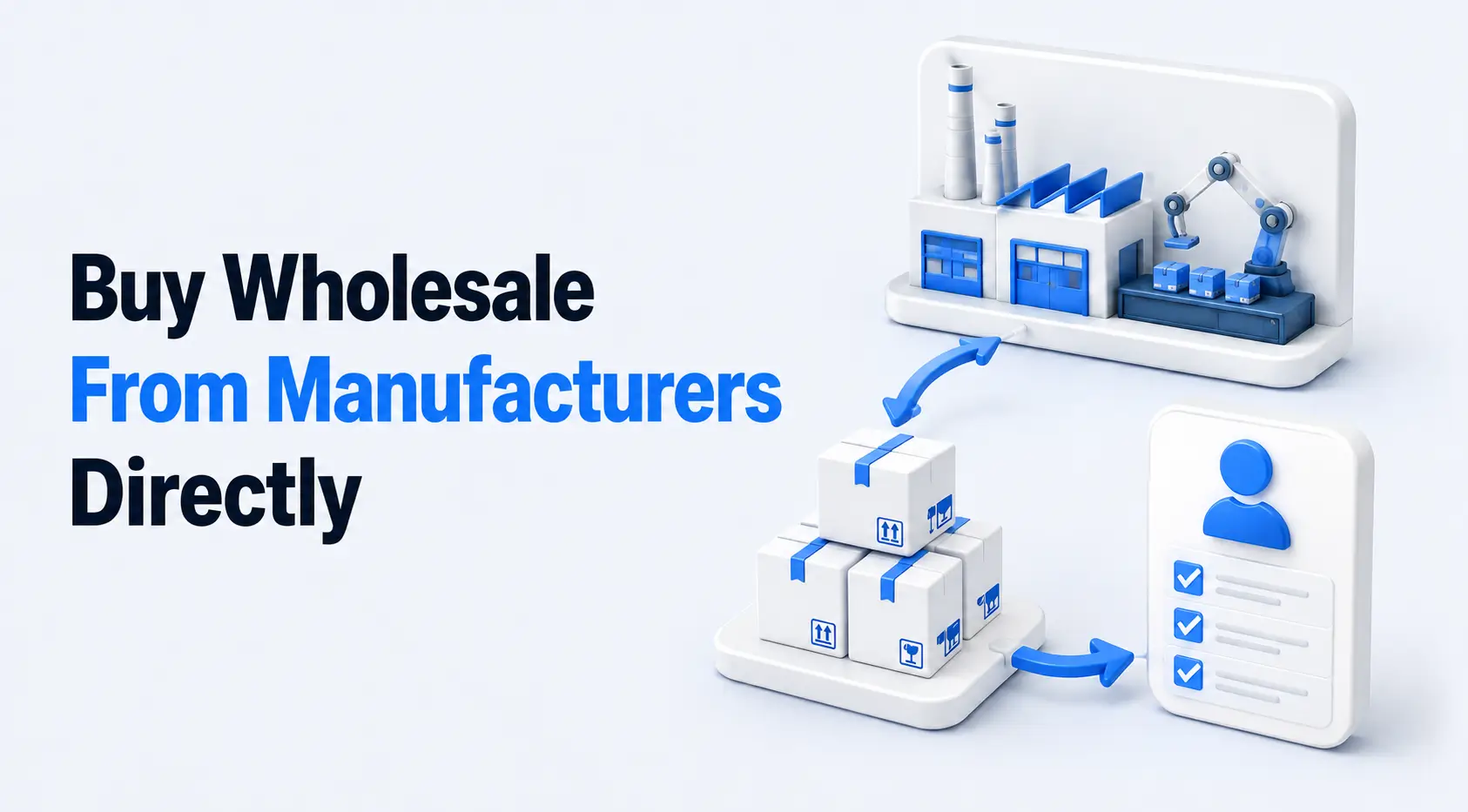
Quick Answer: To buy wholesale directly from manufacturers, define your product and quality requirements, research suppliers through B2B directories, trade shows, or industry associations, vet their credibility and production capacity, then negotiate pricing, MOQs, and payment terms before requesting samples and placing your first order.
Buying wholesale directly from manufacturers can be a powerful way to cut costs and increase profitability, especially for ecommerce and WooCommerce store owners.
When you buy straight from the factory instead of through layers of distributors, you can often reduce intermediary markups, gain access to more product options, and build closer relationships that support long-term growth.
However, the lowest unit price is not always the lowest total cost. To truly benefit when you buy wholesale directly from manufacturers, you need to understand landed cost, vet suppliers carefully, and negotiate clear terms for quality, delivery, and payment.
This guide explains how to buy wholesale directly from manufacturers step-by-step, with practical checks you can use to protect your business while improving margins.
Table of Contents
Why Buy Directly From Manufacturers
Lower Costs and Higher Margins
Cutting out distributor markups means you pay closer to true production cost, especially on bulk orders, which supports stronger profit margins on resale. [Verify from official source] for any specific savings percentage before publishing, as this varies by industry and volume.
Wider Product and Customization Options
Manufacturers often support private labeling, custom packaging, and product variations that generic wholesalers don’t offer, once you meet their minimum order quantity (MOQ).
More Control Over Quality and Supply Chain
Direct relationships let you set quality checkpoints, coordinate production schedules, and align packaging or labeling with your brand — reducing the stockout and quality-inconsistency risks common with resellers.
Recommended Blog for You
👉 How to Create a Wholesale Store in WooCommerce in Just a Few Easy Steps
👉 5 Top WordPress WooCommerce Wholesale plugins for Wholesalers
👉 5 Wholesale Business Ideas That Work
How to Buy Wholesale Directly From Manufacturers: Step-by-Step
Step 1: Define Your Product and Compliance Requirements
Start by documenting a clear sourcing brief before contacting any manufacturer. Include:
- Product details: category, materials, dimensions, colors, functions
- Target customers and price range for your market
- Desired quality tier (budget, mid-range, premium)
- Packaging, labeling, and branding requirements
- Compliance needs for your destination market (e.g., safety, testing, certification, or labeling rules, which vary by product type)
A written specification reduces misunderstandings and gives manufacturers a concrete basis for quotations.
Step 2: Find and Shortlist Manufacturers
Use several channels to identify potential manufacturers:
- Online B2B marketplaces and directories
Platforms that show verified supplier badges, business license information, and on-site inspection data can help you filter initial options. For example, Alibaba’s Verified Supplier program involves independent third‑party inspections of factory registration and production capacity, but it still advises buyers to perform additional due diligence for each transaction. - Trade shows and industry events
Visiting physical or virtual trade fairs lets you see samples, meet factory representatives, and compare multiple suppliers in one place. - Industry associations and local directories
Chambers of commerce, sector associations, and regional business directories often list manufacturers with relevant experience in your niche.
From these sources, build a shortlist that matches your product category, capacity needs, and target region.
Step 3: Verify Credibility and Compare Quotations
Once you have a shortlist, vet each manufacturer carefully.
Confirm business legitimacy and role
- Check whether the company name on the quotation and invoice matches its registration details.
- Verify if the supplier is a manufacturer, a trading company, or both — this affects pricing, control, and communication.
- Request copies of key certificates and confirm them with the issuing bodies when necessary.
Assess quality, capacity, and export experience
- Review detailed product catalogs, material specifications, and quality-control processes.
- Ask for a production timeline, typical lead times, and capacity per order.
- Confirm whether they have export experience to your destination country, including familiarity with customs and documentation requirements.
Request a factory view or third‑party inspection where appropriate
- For larger or higher-risk orders, consider a third‑party factory audit or pre‑shipment inspection.
- In some cases, a live video tour or detailed photos of the production line can help you understand their equipment and processes.
Compare quotations based on landed cost
When you collect quotations, calculate an estimated landed cost per unit that includes:
- Product and packaging cost
- Tooling or setup fees (if any)
- Inspection costs (if you use a third‑party)
- Freight and insurance
- Duties, customs fees, and any domestic transport
Comparing landed cost rather than unit price gives a more accurate picture of profitability.
Step 4: Request Samples, Negotiate Terms, and Place Your First Order
Request samples before bulk ordering
Always request samples that match your specification before committing to a large order. Evaluate:
- Materials and finishing
- Packaging and labeling
- Consistency with your required dimensions and tolerances
Use the approved sample as a reference for mass production.
Negotiate key commercial terms
Discuss and document:
- Unit pricing and volume-based discounts
- MOQ structure (per SKU, per color, per style, or per order value)
- Production and delivery timelines
- Defect rates, remediation policies, and rework or replacement terms
- Packaging and branding details
- Incoterms (e.g., FOB, CIF) which define who handles transport, costs, and risk during shipping
Choose appropriate payment terms
International trade commonly uses several payment methods such as cash in advance, letters of credit, documentary collections, and open-account terms, each balancing risk between buyer and seller.
Manufacturers may request deposits, full advance payment, letters of credit, or other agreed structures. Select payment terms based on supplier credibility, order value, your risk tolerance, and available buyer protection.
Begin with a smaller initial order to validate performance. If everything goes well, you can gradually increase volume and negotiate improved terms over time.
Ways to Buy Wholesale Directly From Manufacturers
Here are some ways to buy wholesale directly from manufacturers.
Using Wholesale Directories
When it comes to buying products directly from manufacturers, wholesale directories can be a real game-changer. These online resources are specially designed to help you find verified manufacturers across different industries.
With just a few clicks, you can get access to contact information, product catalogs, and other essential details that can simplify the purchasing process.
Whether you’re looking to stock up on inventory for your retail business or you simply want to take advantage of bulk pricing for personal use, wholesale directories can connect you with the manufacturers you need.
Reaching out to Manufacturers
Reaching out to manufacturers and starting a conversation can open the doors to exclusive deals and prices. You should introduce your business, explain your product needs, and ask about their wholesale prices, minimum order quantities, and any other important details.
It’s a good idea to research your potential manufacturers in advance to ensure that you’re engaging with a reputable and reliable company. Don’t be afraid to ask questions and negotiate pricing – you could end up with a fantastic deal on high-quality products for your business.
Negotiating Contracts
Buying products for wholesale prices is a great way to save money, but striking the right deal with manufacturers can be tricky. Negotiating contracts is essential when it comes to wholesale purchasing. Make sure to discuss all the relevant terms and conditions that would be best for your business.
Don’t be afraid to ask for discounts, faster delivery times, or special packaging options. A manufacturer is often willing to work with you to create a relationship that benefits both parties. When it comes to buying wholesale directly from manufacturers, the key is to be clear about what you need and to be confident in your negotiation skills.
Requesting Samples
When it comes to purchasing wholesale directly from manufacturers, there are a few important steps to keep in mind. One of the most crucial is requesting samples before you make any larger orders.
This not only lets you evaluate the quality of the manufacturer’s goods but also helps you make an informed decision about whether or not their products are a good fit for your business.
By partnering with reliable wholesale distributors, you can save time and money while ensuring that you have access to high-quality goods that meet your specific needs.
So don’t hesitate to reach out to manufacturers and ask for samples – it may just be the key to making your wholesale purchases a success.
Building Long-Term Relationships
When it comes to getting the best deal on wholesale products, building a relationship with the manufacturer is key. By cultivating a strong partnership, both parties can benefit in the long run. A great way to start building this relationship is by opening a wholesale account with the manufacturer.
From there, maintain open lines of communication and fulfill all commitments on time. Transparency and trust are also essential components of any successful business relationship. By putting in the effort to build a strong and reliable partnership, you can ultimately end up with better pricing and product options for your business needs.
Recommended Blog for You
👉 Effective Marketing Strategies for Wholesale Distributors: Amplify Your Reach
👉 Maximizing Profits With Wholesale Branding: A Comprehensive Guide
👉 How to Become a Wholesaler: A Comprehensive Guide
Key Concepts to Understand When Buying Direct From Manufacturers
Minimum Order Quantity (MOQ)
The smallest order a manufacturer is willing to produce per product, color, style, or order value. MOQs help factories plan efficient production runs but can be negotiated in some cases.
Request for Quotation (RFQ)
A structured request that outlines your product specifications, quantities, packaging requirements, and delivery timelines, sent to multiple suppliers to collect comparable quotations.
Landed Cost
The total cost of a product by the time it reaches your warehouse, including product cost, packaging, inspection, freight, insurance, duties, customs fees, and local delivery.
Private Label, OEM, and ODM
- Private label: Your brand on a product that the manufacturer already produces.
- OEM (Original Equipment Manufacturer): You provide the design; the factory produces to your specification.
- ODM (Original Design Manufacturer): The factory designs and produces the product, which you then brand and sell.
Incoterms
International commercial terms published by the International Chamber of Commerce that define the responsibilities of buyer and seller for delivery, costs, and risk. They complement, but do not replace, the full sales contract.
Red Flags When Choosing a Manufacturer
Watch out for warning signs such as:
- Refusal to share registration or licensing details
- Frequent changes in bank accounts without clear explanation
- Pressure for immediate full payment before any verification
- Inconsistent company names across documents and platforms
- Refusal to provide realistic product samples
- Quotations that are dramatically lower than competitors without clear reasons
- Certificates that cannot be verified with the issuing bodies
- Vague specifications or unwillingness to document agreed standards
- Reluctance to permit inspections or audits
If you encounter multiple red flags, it may be safer to move to another supplier.
First Wholesale Order Checklist
Before placing your first wholesale order directly from a manufacturer, confirm that you have:
- Saved all agreements and key communication in writing
- Verified business registration and supplier role (manufacturer vs trading company)
- Checked certificates relevant to your product and market
- Received and approved product samples
- Compared quotations based on landed cost, not just unit price
- Agreed Incoterms and delivery timelines
- Documented defect and remediation policies
- Chosen appropriate payment terms and verified banking details
- A written product and packaging specification
Frequently Asked Questions
Is buying wholesale directly from manufacturers always cheaper than using wholesalers?
Not always. While you may reduce intermediary markups, higher MOQs, tooling, inspection, and freight can offset savings. Compare total landed cost rather than just ex‑factory unit price.
How do I verify that a supplier is a real manufacturer and not just a trading company?
Check registration information, ask detailed questions about production processes, request factory photos or video, and review certificates. Trading companies often do not operate their own production lines.
Should I start with domestic or overseas manufacturers?
Domestic manufacturers may offer shorter lead times and easier communication. Overseas factories may provide more options or lower ex‑factory prices but involve more logistics and compliance considerations. Choose based on your product type, budget, and operational capacity.
Do I always need a third‑party inspection?
For low‑value or low‑risk orders, you may rely on samples and internal checks. For high‑value or critical products, a third‑party inspection or audit can significantly reduce risk.
Can I use WooCommerce to sell products I source directly from manufacturers?
Yes. Once you have sourced products, you can add them to your WooCommerce store, set wholesale and retail prices, and, if needed, use a WooCommerce wholesale role plugin to manage B2B pricing tiers, minimum order rules, and customer roles.
Final Thoughts on How to Buy Wholesale Directly from Manufacturers
In today’s competitive ecommerce landscape, learning how to buy wholesale directly from manufacturers can be a major advantage. Done well, direct sourcing helps you cut costs, access more customizable products, and build a supply chain that aligns with your brand and growth plans.
To get the full benefit, focus on clear specifications, thorough supplier vetting, realistic landed-cost calculations, and documented quality, delivery, and payment terms before scaling up.
Combine this sourcing approach with a well-optimized WooCommerce wholesale setup, and you’ll be better positioned to increase profitability while maintaining control over your product range and customer experience.