


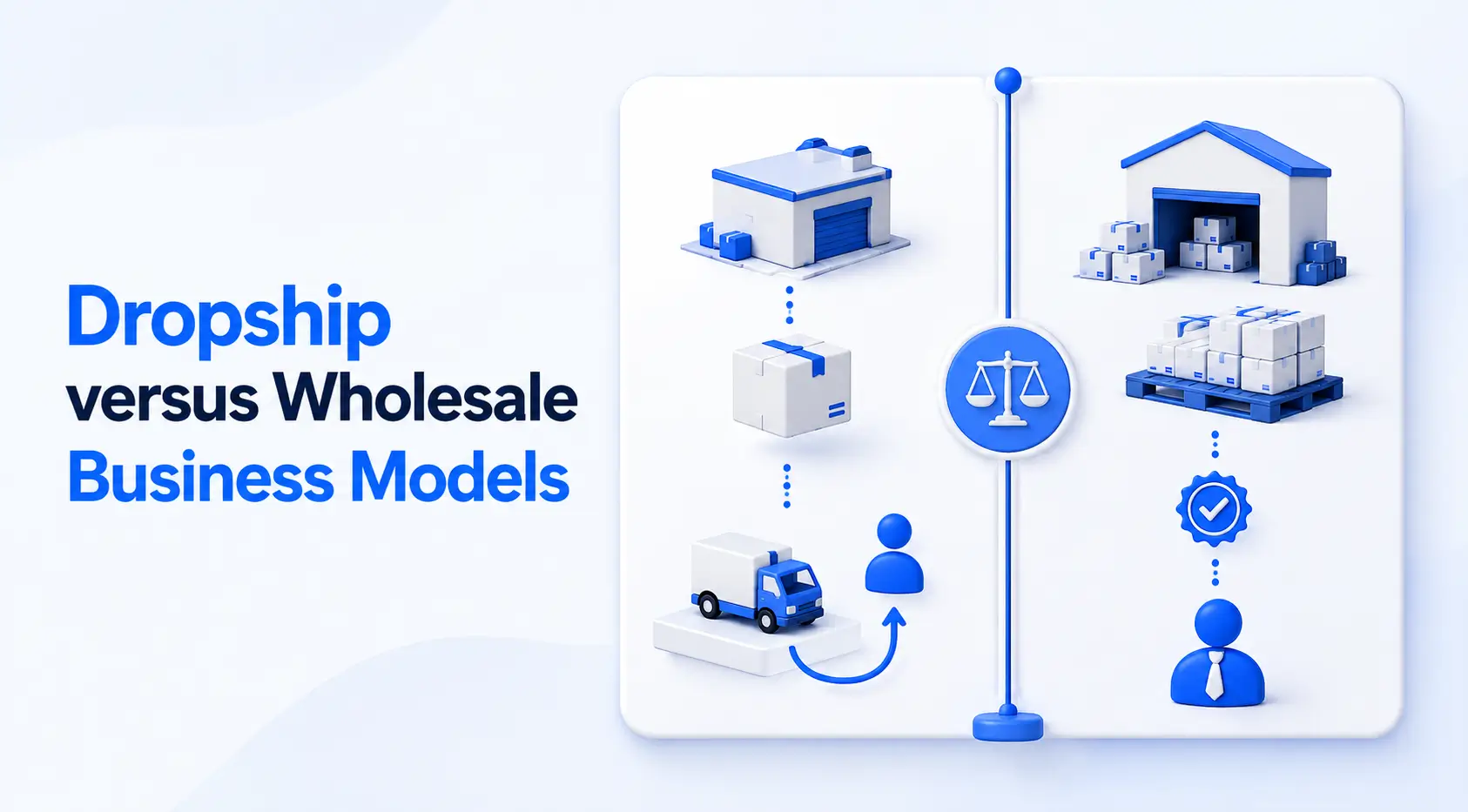
Quick Answer
- Choose dropshipping if you have low startup capital, want to test products fast, and are okay with thinner margins in exchange for lower risk.
- Choose wholesale if you can invest in inventory, want higher profit margins, and need full control over branding and customer experience.
- Choose a hybrid if you want to test products via dropshipping first, then transition winning products to wholesale for better margins — the most flexible and increasingly popular approach.
Starting an eCommerce business means making one foundational decision early on: how will you source and fulfill your products? Two models dominate the space: dropshipping and wholesale, and choosing the wrong one for your situation can cost you time, money, and momentum.
Dropshipping lets you sell without holding any inventory. Wholesale means buying in bulk upfront and managing your own stock. Both are legitimate, proven models — but they serve very different business goals, budgets, and growth stages.
This guide breaks down exactly how each model works, compares them side by side across every major factor, and gives you a clear, honest recommendation based on where you are in your business journey right now.
Table of Contents
Overview of Dropship vs Wholesale

What Is Dropshipping?
Dropshipping is a fulfillment model where you sell products you do not physically stock. When a customer places an order, your supplier ships the product directly to the customer on your behalf. You handle marketing, customer service, and your storefront — the supplier handles inventory, packaging, and shipping.
This model has fueled rapid growth across eCommerce. The global dropshipping market was valued at approximately $365–$414 billion in 2025 and is projected to reach $507–$590 billion in 2026, with a compound annual growth rate (CAGR) of 20–22% through 2030. In the United States alone, the dropshipping market reached $135 billion in 2025, growing at a CAGR of 22.2%.
Key advantages of dropshipping:
- No upfront inventory investment
- Low barrier to entry — launch quickly with minimal capital
- Flexible product testing across multiple niches
- No warehousing or logistics management required
- Easy to scale order volume without physical infrastructure
What Is Wholesale?
Wholesale is a business model where you purchase products in bulk directly from manufacturers or distributors at discounted prices, then resell them to retailers or end customers at a markup. You hold and manage inventory, and you control the full customer experience, packaging, branding, pricing, and fulfillment.freeup+1
Wholesale is a massive and growing sector. The global wholesale market was valued at approximately $57–60 trillion in 2025, projected to reach $63.7 trillion in 2026 and $73 trillion by 2029 at a 6% CAGR. In the United States specifically, the Wholesale Trade industry is sized at $11.6 trillion in 2026, with 748,000 active businesses.
Key advantages of wholesale:
- Higher profit margins from bulk purchasing discounts.
- Complete control over branding, packaging, and customer experience.
- Stronger supplier relationships and more negotiating leverage.
- More predictable inventory and replenishment cycles.
- Better suited for building a long-term, recognizable brand.
👉 Check 5 Top WordPress WooCommerce Wholesale plugins for Wholesalers
Dropshipping vs Wholesale: Full Comparison Table
| Factor | Dropshipping | Wholesale |
|---|---|---|
| Capital needed | Very low. Mainly website, ads, and apps. | Medium to high. Inventory, storage, Packaging |
| Risk | Lower — no unsold stock risk | Higher — cash tied up in inventory |
| Profit margin | Usually lower — per-order supplier fees reduce margins | Usually higher — bulk discounts increase margins |
| Control | Less — supplier controls shipping and quality | Strong — you control the full customer experience |
| Scalability | Fast and easy to scale order volume | Scales with operational investment (warehouse, staff) |
| Brand building | Harder — third-party logistics can affect perception | Easier — full control over unboxing and presentation |
| Complexity | Simpler operations; focus shifts to marketing | More complex — inventory, logistics, and finance to manage |
| Cash flow | Better — pay supplier after customer pays you | Requires capital upfront for bulk purchase |
Decision Framework: Which Model Is Right For You?
Use this step-by-step guide to match your situation to the right model:
- If your startup budget is under $1,000 → Start with dropshipping.
- If you can invest $3,000–$10,000+ and have proven product demand → Consider wholesale.
- If you have no warehouse or storage space → Start with dropshipping.
- If you want full control over packaging, branding, and delivery experience → Choose wholesale.
- If your goal is testing multiple products quickly → Dropshipping is better.
- If your goal is building a strong, repeat-purchase brand → Wholesale is better.joor+1
- If you’re unsure and want to reduce risk while building toward higher margins → Start dropshipping, transition proven winners to wholesale (hybrid model).
Think about your capital, experience level, risk tolerance, and brand goals — then match them to the criteria above.
👉 Learn How to Create a Wholesale Store in WooCommerce in Just a Few Easy Steps
2025–2026 Market Data: Why Both Models Are Growing
Both dropshipping and wholesale are expanding simultaneously, driven by different market forces:
Dropshipping trends:
- The global dropshipping market is valued at $507–$590 billion in 2026 depending on methodology, growing at 20–22% annually.
- Roughly 27% of online stores use dropshipping as their primary fulfillment model, and approximately 23% of all eCommerce sales worldwide come from dropshipped products.
- Growth is driven by new eCommerce entrants seeking low-risk product validation and the expansion of cross-border selling.
Wholesale trends:
- The global wholesale market reached approximately $57–60 trillion in 2025, projected to grow to $63.7 trillion in 2026 and $73 trillion by 2029.
- B2B eCommerce, which is a digital layer of wholesale trade, is projected at $32.1 trillion in 2025, with 80% of B2B sales expected to be conducted digitally by end of 2025.
- Wholesale distribution growth is forecast at approximately 6% CAGR, driven by digital B2B channels, AI automation, and sustainable supply chain innovation
- Wholesale is experiencing a resurgence as many brands shift back from direct-to-consumer (DTC) to wholesale as their most profitable channel.
This data confirms that both models are viable, and the right choice depends on your business stage, not which market is “better.”
The Hybrid Model: Doing Both Dropshipping and Wholesale
Many successful eCommerce businesses combine both models — and this approach is increasingly common.
How the hybrid strategy works:
- Start with dropshipping to test product demand, pricing, and customer interest with minimal capital.
- Identify proven-winner products that consistently sell, get good reviews, and have strong repeat purchase rates.
- Transition those products to wholesale by purchasing in bulk for better margins and more control over quality and delivery.
- Keep experimental or seasonal products as dropshipped items to maintain flexibility.
Benefits of the hybrid model:
- Reduces upfront risk while preserving the path to higher margins
- Allows rapid product diversification without overcommitting capital
- Enables brand consistency on core products while testing new categories
- Maximizes cash flow efficiency across your catalogworldwidebrands+2
If you run a WooCommerce store, you can manage both models in one platform. Tools like the Whols WooCommerce Wholesale Plugin allow you to set up tiered wholesale pricing, manage B2B buyer registrations, and automate bulk order handling, all essential when you’re ready to move to or expand your wholesale channel.
White Label Dropshipping: Branding Without Inventory
A popular middle ground is white label dropshipping, where you dropship products that are manufactured under a generic label and branded as your own.
This approach lets you:
- Build brand recognition and customer loyalty without holding inventory
- Eliminate the “race to the bottom” on price that generic dropshipping often creates
- Launch a branded product line in as little as 2 weeks with low upfront costs.
With the global dropshipping market now valued at approximately $365–590 billion, branding has shifted from optional to essential for standing out in a crowded market.salehoo+1
Read More: White Label Dropshipping: The Ultimate Guide to Branding
Understanding Wholesale Pricing
Whether you choose wholesale or the hybrid model, understanding how wholesale pricing works is critical to protecting your margins.
Key pricing principles:
- Wholesale prices are typically set at 50% of the retail price (a 2x markup), though this varies significantly by industry and product category.
- Pricing errors, especially setting wholesale prices too close to your cost, can eliminate your profit entirely.
- Understanding the difference between markup (percentage added to cost) and margin (percentage of selling price) is essential before setting any wholesale price.
Read More: How to Calculate Wholesale Prices for step-by-step formulas and real product examples.
Read More: How Does Wholesale Work? for a complete breakdown of the wholesale model, supply chain, and buyer relationships.
Clear Recommendation
- For beginners with limited capital: Start with dropshipping. The low risk and zero inventory requirement lets you learn the business, test products, and build your brand without major financial exposure.
- For businesses with proven products and capital: Move to wholesale. The higher margins, full brand control, and stronger supplier relationships will compound into significantly better long-term profitability.
- For the most sustainable growth path: Use the hybrid model. Test everything via dropshipping, then wholesale your winners. This approach balances risk and reward intelligently, and is increasingly the standard operating model for successful eCommerce brands in 2025–2026.
Avoid staying in pure dropshipping indefinitely once your products are proven — you’ll almost always earn better margins with wholesale, and your brand will be stronger for it.
Frequently Asked Questions
Is dropshipping more profitable than wholesale?
No, wholesale typically generates higher profit margins per unit because you buy in bulk at lower per-unit costs. Dropshipping can be profitable, but margins are consistently thinner due to per-order supplier fees and less pricing control. The advantage of dropshipping is lower risk and lower entry cost, not higher profitability.
Can I do both dropshipping and wholesale at the same time?
Yes, and many successful businesses do exactly this. A common approach is to start with dropshipping for product testing, then transition proven bestsellers to wholesale for better margins. This hybrid model gives you flexibility, lower startup risk, and a clear path to higher profitability over time
Which has less risk: dropshipping or wholesale?
Dropshipping has less financial risk because you never buy inventory upfront — you only pay your supplier after a customer pays you. Wholesale carries more risk because capital is tied up in stock that may not sell quickly. However, wholesale also offers higher potential reward in the form of better margins and brand control.
Which model is better for building a long-term brand?
Wholesale is generally better for brand-building, since you control the full customer experience — from packaging and quality to delivery speed. Dropshipping can support branding too, especially with white-label suppliers, but you are more dependent on third-party logistics and product consistency.
What is the minimum capital needed to start each model?
Dropshipping can be started with as little as a few hundred dollars — primarily for website setup and initial marketing. Wholesale typically requires a minimum of $2,000–$10,000+ for initial inventory, depending on the product category and supplier minimums. The actual amounts vary widely by niche, supplier, and business goals.
Is dropshipping still worth starting in 2026?
Yes, especially for product testing, niche validation, and low-capital launches. The global dropshipping market is projected at $507–$590 billion in 2026, growing at 20–22% annually. However, the generic store model is increasingly competitive. Success in 2026 typically requires a focused niche, vetted suppliers, and a clear brand positioning strategy
Final Thoughts on Dropship vs Wholesale
Dropshipping and wholesale are not competitors; they are tools. The right tool depends entirely on your current stage, capital, and goals.
If you are just starting out, dropshipping gives you a low-risk way to test your market, learn what sells, and build your store without tying up capital in inventory. If you are ready to grow, wholesale gives you the margins, brand control, and supplier relationships that build a sustainable, long-term business.
The smartest path for most eCommerce entrepreneurs in 2026 is the hybrid model: start lean with dropshipping, prove your products, then shift your winners to wholesale. This approach minimizes early risk while creating a clear path to higher profitability.
Whatever model you choose, make sure your pricing strategy is solid from day one. Read our guide on How to Calculate Wholesale Prices to make sure your margins are protected and your business is built to grow.