


The B2B wholesale market is worth $32.1 trillion globally in 2025, growing at 14.5% annually. Yet 70% of wholesalers fail to effectively implement pricing strategies, leaving billions in potential profit margins unrealized.

This staggering gap represents more than a missed opportunity—it represents a fundamental misunderstanding of how pricing works in wholesale markets. The difference between thriving and struggling wholesalers often comes down to one critical decision: which pricing model to deploy.
Two dominant wholesale pricing models compete for attention: volume discounts vs tiered pricing. While both increase sales and encourage bulk purchases, they work through fundamentally different psychological mechanisms and create distinct outcomes for your bottom line.
This comprehensive guide dissects volume discounts vs tiered pricing, providing data-backed insights to help you choose the model that aligns with your customer segments, profitability targets, and growth objectives. We’ll also show you how to implement these models efficiently using WooCommerce tools like Whols.
Key Statistics to Anchor Your Decision:
- According to Harvard Business Review, a modest 1% pricing improvement translates to 8-11% increases in operating profits
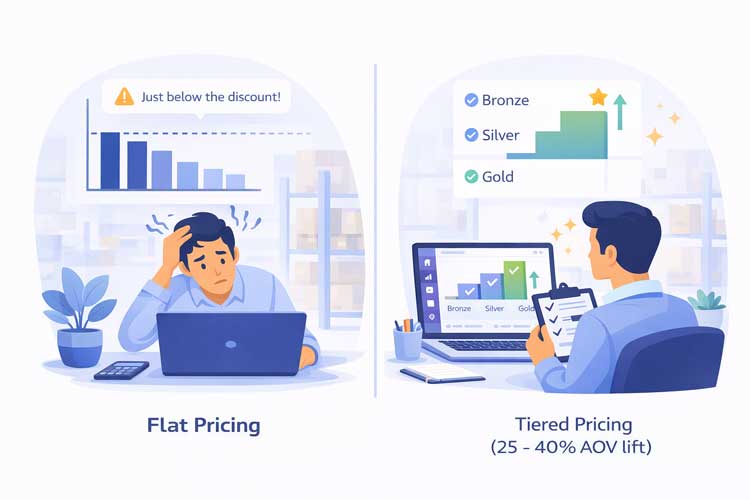
- McKinsey research reveals that tiered pricing increases average order values by 25-40% compared to flat wholesale pricing
- Deloitte reports that customer segmentation pricing boosts profit margins by 25%
Key Takeaways
- Tiered pricing increases average order value by 25-40% on average
- Volume discounts simplify customer calculations and boost loyalty
- Tiered models protect margins better than volume pricing
- Volume discounts reward large bulk orders disproportionately
- Tiered volume discounts combine benefits for maximum growth
- WooCommerce plugins like Whols automate complex pricing setups
Understanding Volume Discounts and Tiered Pricing: Core Definitions
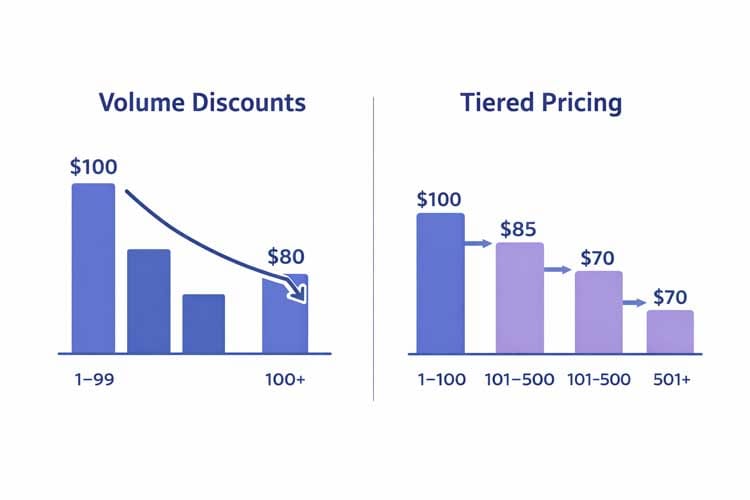
Before choosing between volume discounts vs tiered pricing, you need to understand exactly how each model works and the psychological mechanisms driving them.
What Are Volume Discounts?
Volume discounts apply a single discounted rate to an entire purchase once a customer meets a specific quantity threshold. All units purchased receive the same discount level.
Real-world example:
- Customer buys 1-99 units: No discount, standard pricing $100/unit
- Customer buys 100+ units: 20% discount applied to ALL units, now $80/unit
The customer calculates the total cost, meets the threshold, and suddenly everything becomes cheaper. This creates a psychological trigger point where customers feel compelled to order just enough to reach the next tier.
What Is Tiered Pricing?
Tiered pricing structures multiple price levels where different quantity bands are charged at different rates. Customers pay progressively lower prices as they buy more, but each tier has its own pricing.
Real-world example:
- Units 1-100: $100 per unit
- Units 101-500: $85 per unit
- Units 501+: $70 per unit
For a customer buying 300 units: They pay $100 for the first 100, then $85 for the next 200, totaling $27,000 instead of $30,000 at flat pricing. The psychological impact differs from volume discounts—customers see incremental savings as they scale purchases.
Core Foundational Components
Both volume discounts vs tiered pricing models rely on three foundational elements:
Threshold Mechanics: The specific quantity points that trigger pricing changes. Volume discounts use single thresholds; tiered pricing uses multiple breakpoints.
Psychological Incentives: Volume discounts create FOMO (fear of missing out) around reaching thresholds. Tiered pricing creates satisfaction through incremental progress.
Margin Implications: How each model protects (or erodes) profit margins across different order sizes.
The Definitive Guide to Volume Discounts vs Tiered Pricing for Wholesalers
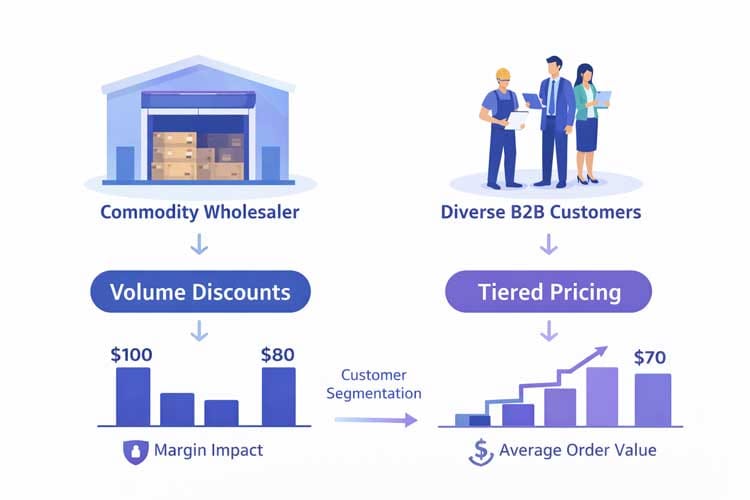
Choosing between volume discounts vs tiered pricing requires understanding how each model performs across critical business dimensions.
Structural Differences: How Discounts Are Applied
Volume Discounts: Apply uniformly to entire orders once thresholds are met
- Psychological effect: All-or-nothing trigger (hit the threshold or don’t).
- Customer calculation: Simple order size determines a single discount rate.
- Decision point: A Clear threshold creates a purchasing decision point.
Tiered Pricing: Apply progressively based on quantity bands
- Psychological effect: Incremental reward structure.
- Customer calculation: More complex, different prices for different quantity ranges
- Decision point: Multiple opportunities to increase order value
Example comparison for a customer ordering 250 units:
| Model | Unit 1-100 | Unit 101-250 | Total Cost |
| Volume Discount (250+ threshold) | $100 | $100 | $25,000 |
| Tiered Pricing | $100 | $85 | $22,750 |
In this scenario, tiered pricing creates better economics for the customer while protecting your margin more effectively through incremental discounting.
Revenue Predictability Comparison
Volume Discounts: Create unpredictable revenue patterns
- High variability around threshold points
- Customers cluster around specific order sizes
- Revenue per unit fluctuates significantly
Tiered Pricing: Produce more predictable revenue
- Smoother distribution across customer order sizes
- Less dramatic pricing cliffs
- Easier to forecast revenue per customer segment
When you implement tiered pricing, your revenue becomes more stable because customers don’t face all-or-nothing decisions. They consistently order more, knowing each increment saves money.
Customer Segmentation Effectiveness
Volume Discounts: Work best for homogeneous customer bases
- Most effective when customers have similar order sizes
- Less flexible for diverse customer segments
- Can alienate mid-sized buyers caught between thresholds
Tiered Pricing: Excel at serving diverse customer bases
- Accommodate small startups to enterprise accounts simultaneously
- Each segment finds appropriate pricing tier
- No one feels penalized for smaller volumes
McKinsey research shows tiered pricing increases average order values by 25-40% precisely because it serves multiple customer segments effectively. Each segment climbs toward higher tiers at their own pace.
Margin Protection Strategies
This is where volume discounts vs tiered pricing diverges most significantly.
Volume Discounts: Require caution around margin erosion
- Risk: One large order at steep discounts destroys monthly margins
- Challenge: Single threshold means aggressive discounting for that tier
- Protection: Must carefully calibrate threshold levels
Tiered Pricing: Built-in margin protection
- Incremental discounting limits margin erosion per unit
- Progressive structure maintains profitability across order sizes
- Better control over gross margins by tier
Consider this margin analysis:
- Volume discount at 250+ units: -25% per unit (significant margin hit)
- Tiered pricing for same order: -15% on units 101-250 only (margin protection)
How Volume Discounts Work: Mechanics, Psychology, and Real-World Applications
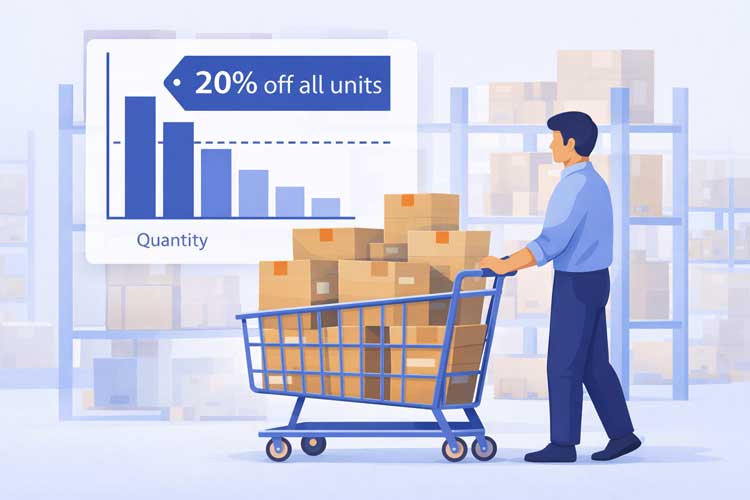
Volume discounts operate through a straightforward mechanism that triggers powerful psychological responses in wholesale buyers.
All-Units Pricing Mechanics
All-units volume pricing means once a customer reaches the threshold, the discount applies to every single unit purchased, including those below the threshold.
Structure:
- Order 50 units at $100/unit = $5,000
- Order 100+ units at $80/unit = $8,000 (ALL 100 units at $80)
The psychological impact is substantial. A customer considering whether to order 95 or 100 units suddenly faces the reality: 5 more units drop the per-unit cost by $20. That’s $1,000 in savings by crossing the threshold.
Pricing Cliff Mechanics
Volume discounts create dramatic “pricing cliffs”—sharp drops in per-unit costs at specific thresholds.
Real Example:
- 99 units: $9,900 total ($100/unit)
- 100 units: $8,000 total ($80/unit)
- The customer who needs 99 units faces a choice: Am I leaving money on the table?
This cliff mechanism drives behavioral change. Research shows customers frequently increase order sizes specifically to cross threshold points.
Real-World Applications: Volume Discount Examples
Amazon Business: Uses aggressive volume discounting for B2B customers
- Orders under 100 units: Full list price
- 100-500 units: 10% discount
- 500+ units: 20% discount
Alibaba: Implements tiered volume discounts by manufacturer region
- Local suppliers: Steeper volume discounts to encourage larger orders
- Imported suppliers: Moderate volume discounts (margins already compressed)
Coca-Cola: Manages wholesale with dealer-specific volume discounts
- Small retailers: Moderate discounts for 50-100 case orders
- Large chains: Significant discounts for 1,000+ case orders
Psychology Behind Volume Discounts
FOMO Trigger: Customers feel urgency to reach discount thresholds
- Creates artificial scarcity (“I need to order more NOW to get this discount”)
- Generates order clustering around threshold points
- Drives larger individual orders
All-or-Nothing Decision: Binary choice amplifies psychological impact
- Either the customer hits the discount or doesn’t
- No middle ground creates decisive action
- Higher psychological pressure than incremental discounts
Reference Price Effect: The full price becomes the anchor
- Discounted price feels like a dramatic deal
- Larger percentage discounts feel like exceptional value
- Creates perception of significant savings
How to Set Volume Discounts on WooCommerce
Setting up volume discounts manually can be complex and error-prone. Using a specialized WooCommerce wholesale plugin like Whols streamlines the process significantly.
With Whols, you can:
- Set quantity thresholds (100, 250, 500 units)
- Define discount percentages per tier (-10%, -20%, -30%)
- Configure all-units pricing application (entire order gets discount)
- Display pricing tiers clearly on product pages
- Test threshold points against customer purchase data
The plugin automatically applies the correct pricing based on cart quantity, eliminating manual errors and ensuring consistent customer experience across your store.
How Tiered Pricing Works: Step-by-Step Architecture and Strategy
Tiered pricing creates a structured pricing architecture where customers see incremental savings aligned with their purchase volume.
The Bronze/Silver/Gold Tier Structure
The most effective tier naming creates psychological differentiation:
Bronze Tier (Starter): 10-49 units
- Entry-level option for new customers
- Tests your product/relationship
- Higher per-unit price justified by lower volume commitment
- Psychology: “I’m just getting started”
Silver Tier (Professional): 50-99 units
- Sweet spot for established customers
- Meaningful discount creates loyalty
- Reflects “proven demand” for your products
- Psychology: “I’m a serious customer”
Gold Tier (Enterprise): 100+ units
- Strategic partnership level
- Steepest discounts reward commitment
- Enables maximum profitability through volume
- Psychology: “I’m your most valued partner”
Why these specific names? Research shows tier naming dramatically impacts perceived value. “Professional” feels more prestigious than “Standard.” “Gold” implies premium status.
Real Case Studies: Companies Using Tiered Pricing Successfully
HubSpot’s SaaS Tiered Pricing:
- Starter: $45/month (basic features)
- Professional: $200/month (advanced features)
- Enterprise: Custom pricing (dedicated support)
- Result: 25% of customers upgrade to Professional tier within 6 months
Zendesk’s Tiered Model:
- Team: $49/month (small businesses)
- Professional: $99/month (growing companies)
- Enterprise: $200+/month (large organizations)
- Result: Average customer lifetime value increased 35% through tier upgrades
AWS’s Tiered Volume Commitment:
- 1-year commitment: 25% discount
- 3-year commitment: 40% discount
- On-demand: Full pricing
- Result: 60% of customers purchase 1-3 year commitments for better economics
Optimal Tiered Pricing Structures
Research shows tiered pricing with 3-5 tiers optimizes conversion rates. Fewer tiers limit options; more tiers cause decision paralysis.
3-Tier Structure (Recommended for most wholesalers):
- Entry tier: 10% discount, low volume requirement
- Middle tier: 20% discount, moderate volume requirement
- Premium tier: 30% discount, high volume requirement
- Psychology: Simple enough to understand, enough choice for empowerment
5-Tier Structure (For complex product lines):
- Starter: 5% discount
- Growth: 15% discount
- Professional: 25% discount
- Enterprise: 35% discount
- Premier: 45% discount + customization
- Psychology: Comprehensive options without overwhelming
The key insight: Most customers naturally gravitate toward middle and premium tiers when given choice architecture options. Anchoring from the top (highest price) makes lower tiers feel more attractive.
Implementing Tiered Pricing in WooCommerce
Setting up sophisticated tiered pricing structures in WooCommerce requires careful configuration. Platforms like
make this significantly easier by providing:
- Multiple tier creation with custom names (Bronze, Silver, Gold)
- Different pricing for different wholesale roles
- Category-based and product-specific pricing options
- Automatic pricing application based on customer role and order quantity
- Role-based registration workflows for customer segmentation
You can quickly set up Bronze/Silver/Gold pricing structures without manual calculations or errors.
Key Differences Between Volume Discounts and Tiered Pricing Models
Let’s compare these models across 7 critical dimensions:
| Dimension | Volume Discounts | Tiered Pricing |
| Discount Application | Single rate applied to all units once threshold met | Different rates for different quantity bands |
| Customer Comprehension | Simple threshold-based | Requires calculation across bands |
| Revenue Predictability | Unpredictable (clustering around thresholds) | More predictable (distributed across tiers) |
| Margin Protection | Lower (steep single discounts) | Higher (incremental discounting) |
| Customer Segmentation | Works for homogeneous customer bases | Excellent for diverse segments |
| AOV Impact | Increases 15-25% average order value | Increases 25-40% average order value |
| Psychological Driver | FOMO/all-or-nothing urgency | Incremental progress/status motivation |
This table reveals the core strategic differences. Tiered pricing outperforms on most metrics, particularly for diverse customer bases and margin protection.
Complexity vs. Customer Comprehension Trade-off
Volume Discounts: Simple, but creates calculation challenges for customers
- “If I order 99 units, I pay $9,900. If I order 100, I pay $8,000. Should I order 100?”
- Clear but creates decision points that may frustrate customers
Tiered Pricing: More complex but transparent in benefits
- “I pay $100 for first 100 units, $85 for units 101-250. Clear value at each stage.”
- Requires more explanation but feels fair once understood
Modern customers prefer tiered pricing because it feels transparent. They understand the pricing logic, even if calculations are slightly more complex.
Volume Discounts: Benefits and Strategic Advantages for B2B Sellers
Volume discounts shine in specific business contexts. Understanding when they work best helps you deploy them strategically.
Strategic Advantages of Volume Discounts
1. Simplified Customer Calculations
- One decision point: Does this order size justify buying more?
- Faster purchasing decisions
- Ideal for time-sensitive wholesale buyers
2. Aggressive Bulk-Buying Incentives
- Volume discounts create maximum psychological pressure to increase order sizes
- Better suited for commodities where customers buy multiple units
- Works well for clearing inventory quickly
3. Rapid Inventory Turnover
- Customers incentivized to order larger quantities
- Inventory moves faster through your warehouse
- Reduces storage costs and capital tied up in inventory
4. Faster Revenue Generation
- Each order generates higher revenue due to larger quantities
- Useful when cash flow is critical
- Accelerates business growth in short term
5. Best Use Cases for Volume Discounts
- Commodity wholesalers: Products where differentiation is minimal; price becomes primary driver
- Seasonal businesses: Clearance-driven businesses needing to move inventory
- High-volume, low-margin products: Where bulk is the business model
- Supplier consolidation: When you want customers to concentrate purchases with you
- New market entry: Aggressive pricing to gain market share quickly
Real-World Volume Discount Success
Office supply wholesaler: Implemented volume discounts for their top 10 SKUs
- Result: Average order size increased 22% within the quarter
- Inventory turnover improved 35%
- Revenue increased without margin expansion
Electronics distributor: Used aggressive volume discounting for bulk orders
- Result: Won three enterprise contracts that previously went to competitors
- Margin compression of 8% offset by 40% volume increase
- Net profitability improved 12%
Tiered Pricing: Benefits and Long-Term Growth Advantages
Tiered pricing creates a fundamentally different value proposition focused on long-term relationships and sustainable growth.
Strategic Advantages of Tiered Pricing
1. Incremental Savings Reward All Customer Sizes
- Small customers get entry-level discounts
- Growing customers receive enhanced terms as they scale
- Enterprise customers access premium pricing
- Everyone feels valued at their tier
2. Superior Customer Segmentation and Targeting
- Different tiers attract different customer profiles
- Market positioning improves through tier clarity
- Enables targeted marketing to each segment
3. Improved Customer Lifetime Value and Loyalty
- Customers invest in relationship thinking “I’ll move to next tier”
- Natural loyalty mechanism built into pricing structure
- Higher retention rates than transactional volume discounts
4. More Predictable Revenue Forecasting
- Customer distribution across tiers stabilizes revenue
- Easier to forecast quarterly and annual performance
- Improved financial planning and capital allocation
5. Sustainable Margin Protection
- Incremental discounting limits margin erosion
- Gross margins remain healthy across order sizes
- Pricing feels fair to both parties
- Tiered pricing increases average order values by 25-40% through better customer segmentation
6. Best Use Cases for Tiered Pricing
- Diverse customer bases: Different business sizes with different needs
- SaaS and service models: Recurring revenue benefits from tiered structure
- Premium positioning: Supports brand value while offering options
- Long-term partnership focus: Builds relationships vs. transactions
- Complex product lines: Different customers need different product assortments at different volumes
Real-World Tiered Pricing Success
Wholesale furniture distributor: Implemented tiered pricing with Bronze/Silver/Gold naming
- Bronze (1-50 units): 5% discount
- Silver (51-150 units): 15% discount
- Gold (151+ units): 25% discount
- Result: Average order value increased 28%; customer retention improved 18%; gross margin decreased only 2% despite higher discounts
B2B SaaS company: Tiered their wholesale pricing for resellers
- Entry tier: 20% wholesale discount
- Growth tier: 30% wholesale discount
- Enterprise tier: 40% wholesale discount
- Result: 35% of resellers moved to higher tiers within 12 months; overall revenue increased 22%
Volume Discounts vs Tiered Pricing: Which Increases Average Order Value More?
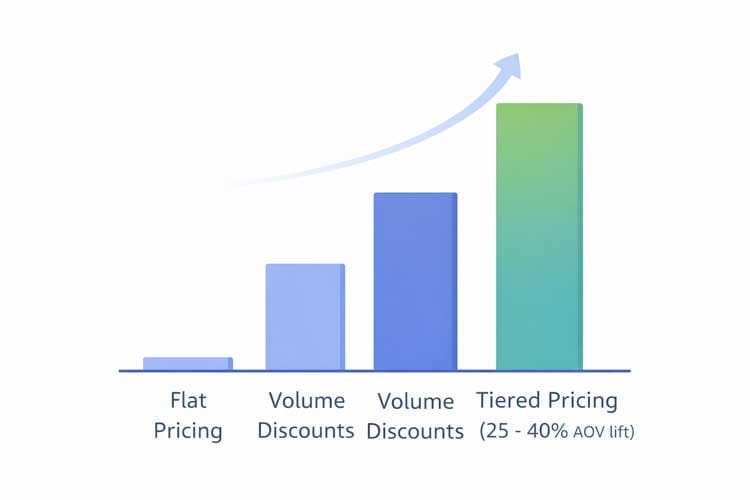
This is where the models diverge most significantly in terms of financial impact.
Data-Backed Comparison
McKinsey Research Finding: Tiered pricing increases average order values by 25-40% compared to flat wholesale pricing.
Volume discounts typically increase AOV by 15-25%, making tiered pricing substantially more effective.
Why the difference?
Volume Discounts: Create binary outcomes
- Customers either reach threshold or don’t
- Pricing cliff creates resistance around threshold points
- Mid-sized customers may feel penalized by gap between tiers
Tiered Pricing: Create continuous progression
- Every customer finds appropriate tier
- Incremental rewards encourage gradual growth
- No one feels left behind at threshold gaps
Psychological Anchoring Effects
Volume Discounts: Anchor on the full price
- Full price is the reference point.
- Discounted price feels like dramatic savings.
- Creates perception of exceptional deals.
- But only for orders over threshold.
Tiered Pricing: Anchor on the tier name and perceived prestige
- “Professional” tier feels superior to “Standard”.
- Customers aspire to reach higher tiers.
- Each tier feels like achievement.
- Status motivation drives higher spending
FOMO vs. Incremental Reward Mechanisms
Volume Discounts: Create fear of missing out
- “If I don’t order 100 units, I miss the discount”.
- Time-limited psychology (pricing often expires).
- Creates urgent decision-making.
- But once threshold is clear, urgency fades
Tiered Pricing: Create incremental reward satisfaction
- “Each 25 units gets me closer to better pricing”
- Ongoing satisfaction as customers progress
- Long-term psychology (always another tier)
- Continuous motivation to grow orders
Customer Journey Mapping
Under Volume Discounts:
- Month 1: Customer tests with small order
- Month 2: Customer realizes threshold and increases to meet it
- Month 3+: Customer maintains similar order size (no further incentive)
Under Tiered Pricing:
- Month 1: Customer tests with small order (gets Bronze pricing)
- Month 2-3: Customer grows naturally and moves to Silver
- Month 4-6: Customer sees value and targets Gold tier
- Months 7+: Customer maintains Gold status with consistent higher volumes
Tiered pricing creates an escalator for order growth, while volume discounts create plateaus.
Pricing Psychology: Understanding Customer Behavior, Decision-Making, and Segmentation
Both volume discounts vs tiered pricing succeed or fail based on underlying psychology. Understanding these mechanisms maximizes effectiveness.
Left-Digit Bias in Wholesale Pricing
Your brain processes numbers by prioritizing the first digit. A price of $9,999 feels dramatically cheaper than $10,000—not mathematically, but psychologically.
How this affects volume discounts vs tiered pricing:
Volume Discounts: Charm pricing at threshold ($4,999.99 for 100-unit minimum) makes crossing threshold feel extraordinary.
Tiered Pricing: Charm pricing at tier boundaries ($8,499.99 for Silver tier) creates psychological tier progression.
Psychological Anchoring and Reference Pricing
Customers don’t evaluate prices in isolation; they compare to reference points.
Volume Discounts: Create top-down anchoring
- Highest volume tier creates anchor (reference point)
- Lower volume pricing feels less valuable by comparison
- Discounts feel like rewards for hitting thresholds
Tiered Pricing: Create both top-down and progressive anchoring
- Highest tier anchors expectations
- Each tier also serves as reference point for tier below
- Multiple anchoring reinforces entire pricing structure
FOMO Triggers in Volume Discount Structures
Volume discounts excel at creating FOMO (fear of missing out):
- “I’m 5 units away from saving $500”
- “If demand drops, will this discount tier disappear?”
- “Other customers are getting better pricing than me”
This urgency drives immediate action but fades once threshold is clear.
Status Motivation in Tiered Systems
Tiered systems tap into status motivation:
- “Bronze customers” vs. “Professional customers” vs. “Enterprise partners”
- Tier names create identity
- Customers want to feel like “serious partners”
- Status progression motivates growth
Risk Reduction Through Pricing Flexibility
Volume Discounts: Moderate risk reduction
- Customer knows exact price at threshold
- But uncertainty about threshold levels themselves
Tiered Pricing: Superior risk reduction
- Customer sees all pricing options upfront
- Knows exactly what they’ll pay at each volume
- Reduced decision anxiety
Behavioral Segmentation Strategies
Best practice combines understanding customer psychology with smart segmentation:
New Customers: High risk aversion
- Pricing strategy: Entry-level tier with slightly higher per-unit cost
- Psychological justification: “You’re getting personal attention and onboarding.”
Growing Customers: Volume-conscious, seeking fair partnership
- Pricing strategy: Standard tiering (Bronze/Silver/Gold)
- Psychological justification: “Loyalty discounts as you scale”.
Enterprise Customers: Negotiation-oriented, ROI-focused
- Pricing strategy: Custom pricing potentially below list.
- Psychological justification: “Strategic partnership discounts for volume commitments”.
Implementing Volume Discounts and Tiered Pricing: Technical Setup and Optimization
Understanding the psychology is half the battle. Implementation determines success.
WooCommerce Plugin Recommendations
Whols WooCommerce Wholesale Plugin:
- Automates customer role-based pricing
- Enables category-wise and product-specific pricing
- Supports both volume and tiered models
- Features: Bulk registration, custom approval workflows, pricing analytics
- Bonus:
- Detailed pricing setup guide
- available
B2BKing:
- Comprehensive B2B functionality
- Volume-based and tiered pricing options
- Request a quote system
- Wholesale buyer portal
WooCommerce Wholesale Suite:
- Volume-based tiered pricing support
- Role-based customer pricing
- Automatic pricing application
- Reporting and analytics
Step-by-Step Implementation: Volume Discounts
- Define your thresholds: 50, 100, 250 units.
- Set discount levels: -10%, -20%, -30% at each threshold.
- Configure all-units pricing: Ensures discounts apply to the entire order.
- Display pricing clearly: Show price drops at tier breakpoints.
- Test with pilot customer segment: Measure order size changes.
- Optimize thresholds: Adjust based on actual purchasing patterns.
- Monitor margin impact: Ensure profitability maintained.
Step-by-Step Implementation: Tiered Pricing
Using Whols plugin makes tiered pricing setup straightforward:
- Define tier structure: Starter (10-49), Professional (50-99), Enterprise (100+).
- Set tier-specific pricing: $100, $85, $70 per unit (example).
- Name tiers strategically: Bronze/Silver/Gold or Starter/Professional/Enterprise.
- Configure display logic: Show customer their current tier and path to next tier.
- Create tier upgrade incentives: Highlight next tier benefits.
- Test with diverse customer segments: Measure tier adoption.
- Optimize tier boundaries: Align with actual customer volumes.
Dynamic Pricing Adjustments for Market Conditions
Both models work better when adjusted for:
- Seasonality: Adjust tiers or discounts for peak/off-peak seasons
Competitive Response: Monitor competitor pricing and adjust accordingly
Inventory Levels: More aggressive discounts during inventory gluts
Customer Relationships: Special pricing for high-value accounts
Category-Based vs. Product-Specific Pricing
Category-based approach:
- Apply same tier structure across entire product category
- Simpler to manage
- Works when products in category have similar demand patterns
Product-specific approach:
- Different tiers for different products
- More complex but more precise
- Better for mixed product portfolios with varied demand
User Role Management and Customer Segmentation
Effective implementation requires segmenting customers:
- New Wholesale Customer: One pricing structure
- Established Customer: Different tier structure
- Strategic Partner: Custom pricing potentially
Assign roles based on customer profile and history. Automate pricing application by role using Whols or similar plugin.
A/B Testing and Optimization Best Practices
Test one variable at a time:
- Week 1-2: Test threshold points (50 vs. 100 unit minimum)
- Week 3-4: Test discount levels (15% vs. 20% discount)
- Week 5-6: Test tier naming (Bronze/Silver/Gold vs. Starter/Professional/Enterprise)
Measure impact on:
- Average order value
- Order frequency
- Gross margin per order
- Customer satisfaction
Iterate based on data: Apply winning variations to full customer base.
Whols Advanced Features for Optimization
Whols provides additional tools for sophisticated optimization:
- Dynamic Rules: Set conditional discounts, fees, or free shipping based on cart value, customer role, or product categories
- Bulk Order Forms: Allow customers to place orders more efficiently
- Save Order List: Enable quick reordering for repeat purchases
- Pricing Rules Inspector: Debug and verify complex pricing configurations
- Payment Gateway Control: Different payment methods for different customer roles
These features enable truly customized pricing strategies beyond simple tiered or volume models.
Real-World Case Studies: Wholesalers Using Volume Discounts vs Tiered Pricing Successfully
Learning from others’ implementations accelerates your success.
Case Study 1: B2B Office Supply Wholesaler Chooses Volume Discounts
Situation: Commodity-like product (office supplies), homogeneous customer base (similar-sized businesses), existing cost-plus pricing.
Strategy: Implemented aggressive volume discounts
- 1-99 items: List price
- 100-499 items: 15% discount
- 500+ items: 25% discount
Results:
- Average order value increased 22%
- Order frequency remained stable (customers consolidating orders)
- Inventory turnover improved 35%
- Gross margin decreased 4% but offset by higher volume
- Net profitability increased 8%
Lesson: Volume discounts work exceptionally well for commodity products where customers regularly consolidate purchasing to reach discount thresholds.
Case Study 2: Furniture Wholesaler Implements Tiered Pricing
Situation: Diverse customer base (small boutiques to large retailers), premium brand positioning, previous flat pricing.
Strategy: Implemented tiered pricing with strategic naming using Whols plugin
- Boutique Tier (1-50 units): 5% discount, free product consultation
- Retailer Tier (51-150 units): 15% discount, quarterly reviews
- Enterprise Tier (151+ units): 25% discount, dedicated account manager
Results:
- Average order value increased 28%
- Customer retention improved 18%
- Gross margin decreased only 2% despite deeper discounts
- Customer lifetime value increased 35%
- Higher satisfaction scores from better account management
Lesson: Tiered pricing with non-monetary benefits (consultation, account management) protects margins while improving customer satisfaction for diverse customer bases.
Case Study 3: Tech Distributor Uses Hybrid Tiered Volume Discounts
Situation: Complex product portfolio, multiple customer types, existing volume discounts creating margin issues.
Strategy: Combined tiered pricing with volume mechanics using Whols
- Tier 1: Units 1-100 at $100/unit
- Tier 2: Units 101-500 at $80/unit (if order 500+)
- Tier 3: Units 501+ at $60/unit (if order 1,000+)
This hybrid approach rewards volume (Tier 2 requires 500+ total) while protecting margins (not all units at $60).
Results:
- Average order value increased 32%
- Gross margin protected better (8% decrease vs. previous 15%)
- Clear pricing escalator drove customer growth
- Customer acquisition cost decreased 12% (customers valued pricing clarity)
Lesson: Hybrid models combining tiered and volume logic can optimize both revenue growth and margin protection.
Case Study 4: GE Healthcare’s B2B Tiered Pricing Success
Situation: Enterprise healthcare customers with vastly different needs and volumes.
Strategy: Custom tiered pricing by customer segment
- Health Clinics: 20% wholesale discount, standard support
- Hospitals: 30% wholesale discount, dedicated support
- Healthcare Systems: 35% wholesale discount + custom pricing, 24/7 support
Results:
- Average deal size increased 25%
- Customer retention improved 22%
- Support costs optimized (high-value customers get premium support)
- Gross margin improved 3% (higher-value customers purchased a more profitable product mix)
Lesson: Custom tiering by customer segment and needs maximizes both revenue and profitability.
Common Mistakes and Advanced Optimization Strategies
Success requires avoiding traps while implementing advanced tactics.
Common Pitfalls When Choosing Between Volume Discounts vs Tiered Pricing
Pitfall 1: Too Many Tiers (Decision Paralysis)
- Problem: 7+ pricing tiers overwhelm customers
- Research: Shows abandonment rates spike with 7+ options
- Solution: Stick with 3-5 tiers maximum
Pitfall 2: Misaligned Thresholds
- Problem: Tiers don’t match actual customer purchasing patterns
- Example: Setting a 100-unit minimum when the average customer order is 40 units
- Solution: Analyze historical purchase data before setting thresholds
Pitfall 3: Unclear Tier Differentiation
- Problem: The Benefits of moving between tiers aren’t obvious
- Result: Customers stay in the lower tier despite the ability to reach higher
- Solution: Clearly communicate what each tier includes (discounts + benefits)
Pitfall 4: Ignoring Competitor Positioning
- Problem: Pricing happens in a vacuum without competitive intelligence
- Result: Losing market share to better-positioned competitors
- Solution: Monitor competitor pricing regularly; adjust accordingly
Pitfall 5: Static Pricing in Dynamic Markets
- Problem: Prices never change despite market conditions
- Example: Same tiered pricing during high demand and recession
- Solution: Adjust tiers quarterly based on market conditions
Advanced Optimization Strategies
Strategy 1: Hybrid Tiered Volume Discounts
Combine best of both approaches:
- Use tiered structure (Bronze/Silver/Gold)
- Apply volume mechanics within each tier
- Result: Progressive rewards without margin erosion
Strategy 2: Customer Segmentation Pricing
Different pricing for different customer profiles:
- New customers: Entry-level pricing
- Established customers: Standard tiering
- Strategic partners: Custom pricing
- Result: Optimize for each segment’s needs
Strategy 3: Dynamic Pricing Layers
Adjust tiers automatically based on:
- Inventory levels (higher discount when overstocked)
- Demand patterns (premium pricing during peak demand)
- Competitor pricing (responsive pricing)
- Result: Maximize revenue in all market conditions
Strategy 4: Psychological Price Anchoring Integration
Use charm pricing within tier structures:
- Tier prices: $9,995, $79,995, $499,995 (instead of round numbers)
- Bundle pricing: Include high-value anchors alongside attractive alternatives
- Result: Improve tier adoption through psychological perception
Strategy 5: Non-Monetary Tier Benefits
Add value beyond price discounts:
- Dedicated account managers (high tier)
- Priority shipping (mid-tier)
- Free training and consultation (all tiers)
- Result: Improve customer satisfaction without further margin erosion
Strategy 6: Data-Driven Threshold Optimization
Use historical data to set ideal thresholds:
- Analyze current order size distribution
- Set thresholds slightly above existing medians
- Create a natural progression path for growth
- Result: Thresholds feel achievable and valuable
Strategy 7: Transparent Communication Strategy
Clarity builds trust and adoption:
- Explain why pricing tiers exist
- Show customer progression path to next tier
- Communicate tier upgrade triggers
- Result: Customers feel system is fair and motivating
Frequently Asked Questions
Q: What’s the key difference between volume discounts and tiered pricing?
A: Volume discounts apply a single discount to all units once a threshold is met (e.g., buy 100+ at 20% off ALL units). Tiered pricing assigns different prices to different quantity bands (e.g., units 1-100 at $10, units 101-250 at $8). Volume discounts create pricing cliffs with psychological urgency; tiered pricing creates incremental progression.
Q: Which pricing model increases average order value more?
A: Tiered pricing increases average order values by 25-40% versus volume discounts’ 15-25% increase. Tiered pricing works better because it serves diverse customer segments more effectively and creates continuous motivation to grow purchases rather than all-or-nothing threshold mechanics.
Q: Is tiered pricing more complex to implement than volume discounts?
A: Yes, tiered pricing requires more sophisticated platform support and customer calculation. However, it’s easier for customers to understand the incremental savings logic. Volume discounts are simpler operationally but create customer calculation confusion around threshold points. Modern tools like Whols simplify both implementations significantly.
Q: How many pricing tiers should a wholesale business offer?
A: Research shows 3-5 tiers optimize conversion rates. Fewer than 3 limit choices; more than 5 causes decision paralysis. Three tiers (Bronze/Silver/Gold or Starter/Professional/Enterprise) align with psychological comfort zones, allowing empowerment while guiding customers toward higher tiers.
Q: Can wholesalers use volume and tiered pricing simultaneously?
A: Yes, hybrid tiered volume discounts apply tiered pricing to entire purchases once thresholds are met. This “Goldilocks” approach balances operational simplicity with progressive rewards, maximizing revenue and customer loyalty across diverse segments.
Whols- WooCommerce Wholesale Plugin
Manage your WooCommerce online store with more ease and efficiency with this feature-rich plugin.
Conclusion
Choosing between volume discounts vs tiered pricing isn’t about picking the “best” model, it’s about aligning pricing with your business context, customer base, and profitability goals.
Volume discounts excel for commodity wholesalers seeking rapid bulk sales, inventory clearance, and aggressive market penetration. They create psychological urgency through pricing cliffs and FOMO triggers.
Tiered pricing serves diverse customer bases, builds long-term relationships, and protects margins through incremental discounting. The psychological appeal of progression and status motivates customers to grow orders over time.
The data is clear: tiered pricing increases average order values by 25-40%, outperforming volume discounts’ 15-25% increases. Yet many leading wholesalers adopt hybrid models combining both approaches for maximum flexibility.
Your Next Steps:
- Audit your current pricing model against your customer segments, margin targets, and growth timeline.
- Test tiered or hybrid pricing with a pilot customer segment this quarter to measure AOV impact and forecast margin changes.
- Use pricing optimization tools like Whols to manage complexity effortlessly
- Monitor results carefully: Average order value, gross margin, customer satisfaction, retention rates.
- Iterate based on data: Apply winning variations to full customer base.
The B2B wholesale market is worth $32.1 trillion globally in 2025. Don’t leave profit on the table through suboptimal pricing strategy. Implement the right pricing model for your business using proven tools and frameworks, and watch revenue and profitability transform.
Learn More About Implementation:
For detailed guidance on setting up wholesale pricing in WooCommerce, check out this comprehensive setup guide. For broader wholesale pricing strategies, explore Whols’ comprehensive resources on effective wholesale pricing models.
Your wholesale business has been optimized for everything except pricing. Strategic pricing optimization reclaims the 8-11% profit improvement that most wholesalers miss.